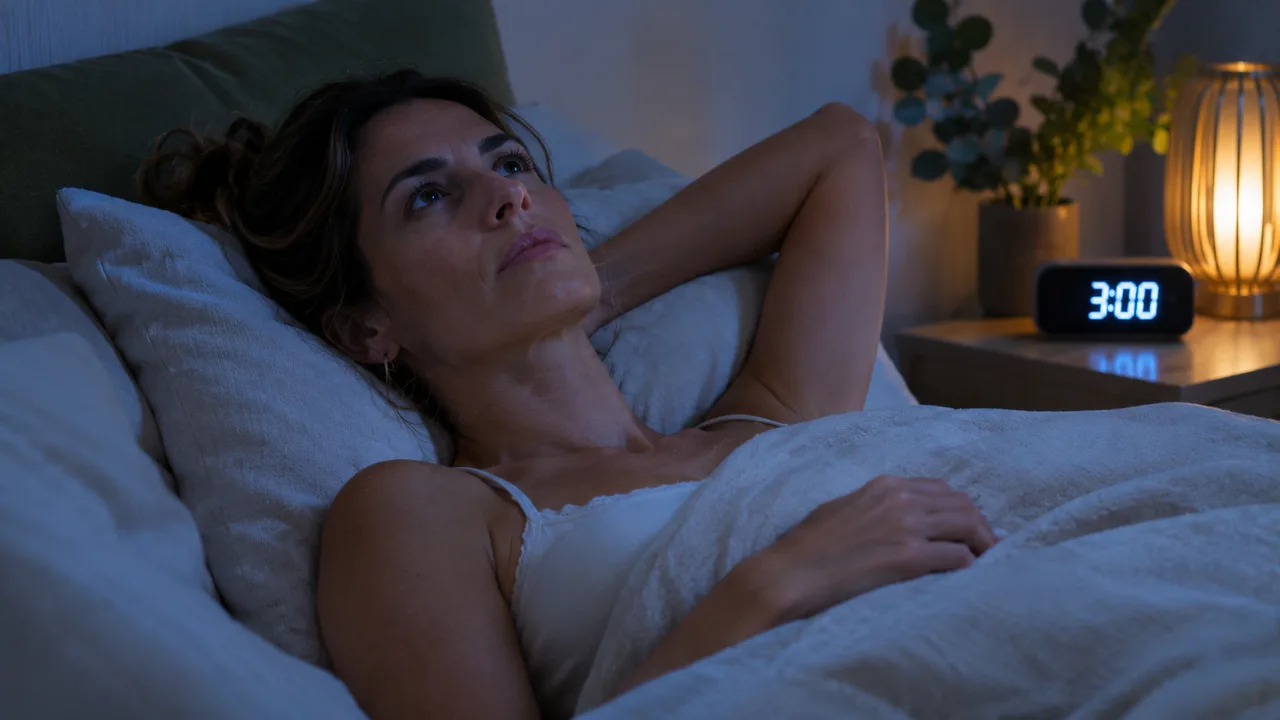
Anxiety and insomnia feed each other: worry switches the body on and makes it hard to sleep, and poor sleep increases emotional reactivity and anxiety the next day. The tool with the strongest evidence for breaking this cycle is cognitive behavioural therapy for insomnia (CBT-I), supported by simple daily habits and, when needed, by care from mental health professionals. In the Integrative Medicine consultation at Centro Ubud, in La Carihuela (Torremolinos), we review your sleep, stress, diet, physical activity and overall health with you to help you understand what is keeping the problem going, and we coordinate with any professionals you need.
Why does anxiety stop me from sleeping?
To fall asleep, the brain needs to lower its guard. When we live with anxiety, the alarm system stays switched on: the heart beats faster, the muscles are tense and the mind goes over to-do lists, conversations or feared scenarios. That state of hyperarousal is incompatible with deep sleep.
At first it may be a bad patch linked to a specific moment. The problem appears when the bed starts to be associated with tossing and turning, checking the clock and worrying about not sleeping. Insomnia then stops depending only on the original anxiety and keeps itself going.
Can poor sleep make anxiety worse?
Yes. The relationship works both ways. After several nights of short or broken sleep we usually notice more irritability, less patience, poorer concentration and a feeling of being “on edge”. Lack of sleep makes negative emotions weigh more and makes them harder to regulate. On top of that, the fear of another bad night becomes one more worry, and so the vicious circle closes.
That is why treating only one side often falls short: working on sleep helps anxiety, and addressing anxiety helps sleep. We explain how we approach it on our page about insomnia in Torremolinos.
What is cognitive behavioural therapy for insomnia (CBT-I)?
The European insomnia guideline, produced by the European Sleep Research Society, recommends CBT-I as the first-line treatment for chronic insomnia in adults, including when it coexists with anxiety, depression or other health problems. It is a structured programme, usually over several sessions, delivered by psychologists and other professionals trained in sleep, in person, in groups or in a guided digital format.
Its main components are:
- Stimulus control: re-associating the bed with sleeping, not with lying awake worrying.
- Sleep restriction or compression: matching the time you spend in bed to the time you actually sleep in order to consolidate sleep. It should be guided by a professional, especially if you have epilepsy, bipolar disorder or a safety-critical job.
- Cognitive restructuring: reviewing beliefs that create pressure, such as “if I don’t sleep eight hours, tomorrow will be a disaster”.
- Relaxation techniques and worry management.
- Sleep hygiene education, which on its own helps little but adds value within the programme.
Studies show that CBT-I improves sleep and often also reduces symptoms of anxiety and depression. Sleeping tablets may have a place in specific situations and for short periods, but that decision, and any change to your medication, always belongs to your doctor.
Integrative medicine consultation in person at Centro Ubud (La Carihuela, Torremolinos) or online by video call. Book your first visit on WhatsApp.
Which habits help you sleep better when you have anxiety?
These habits are safe for most people and complement, rather than replace, treatment:
- A fixed wake-up time, at weekends too. It is the anchor of your body clock, more important than the time you go to bed.
- Go to bed when you feel sleepy, not just tired. If you have been awake for a long while and feel wound up, get up, do something calm in dim light and go back when you feel sleepy.
- Natural light in the morning. An early walk along the promenade in La Carihuela or Benalmádena helps synchronise your circadian rhythm.
- Regular movement. Aerobic and strength exercise has evidence for both sleep and anxiety. Ideally not intense right before bed.
- A cut-off time for caffeine: avoid coffee, tea, cola and energy drinks from early afternoon.
- Be careful with alcohol. It may feel relaxing, but it fragments sleep in the second half of the night and worsens anxiety the next day.
- Light dinners, not too late, following the Mediterranean pattern: vegetables, pulses, fish, olive oil, fruit.
- A “wind-down hour” before sleep: screens away, warm light, a lukewarm shower, reading or slow breathing.
- “Worry time”: in the late afternoon, spend ten or fifteen minutes writing down what is bothering you and the next possible step. That way the bed stops being the place where you think everything through.
- Keep the clock out of sight. Checking the time during the night increases arousal.
When should I see a psychologist or psychiatrist about anxiety and insomnia?
Asking a mental health professional for help is not a last resort; it is a sensible decision. We recommend seeing a clinical or health psychologist, or your GP to consider a referral to psychiatry, if:
- Anxiety interferes with your work, your relationships or your daily life.
- You have panic attacks, avoid places or situations out of fear, or live in constant worry.
- You notice persistent sadness, loss of interest in things or a feeling of hopelessness.
- Insomnia happens three or more nights a week for more than three months.
Ideally, the approach to sleep and to anxiety should be coordinated. Many psychologists apply CBT-I and anxiety therapy within the same process.
How can integrative medicine in Torremolinos help?
The integrative medicine consultation in Torremolinos with Dr Paloma Gómez, a doctor with training in nutrition and integrative medicine, looks at sleep within your health as a whole. It is important to say it clearly: it does not replace your medical or psychological treatment: it complements it.
In the first consultation we review your history, your sleep pattern, your stress level, your diet, your physical activity and the medication you take. We also assess whether there are medical factors that may be worsening your rest or your anxiety, such as thyroid disorders, iron deficiency, chronic pain, menopausal hot flushes, digestive problems or night-time reflux, and whether blood tests or a referral to another specialist would be advisable. If you are also dragging constant tiredness, you may want to read about chronic fatigue in Torremolinos.
With all of this we design a realistic habit plan tailored to you, and we coordinate with your doctor, with mental health professionals and, if there is pain or physical tension, with the clinic’s physiotherapists. We see patients in person in La Carihuela and also online by video call, for people from Málaga, Benalmádena and the whole Costa del Sol. Book your first consultation: message us on WhatsApp.
When should I see a doctor or go to A&E?
If at any point you have thoughts of harming yourself or that life is not worth living, you are not alone and you do not have to wait for an appointment. In Spain, call 024, the suicide prevention line available 24 hours a day, or 112 if there is immediate risk. Talking to someone you trust also helps.
Go to A&E or call 112 if you have chest pain, severe shortness of breath, palpitations with dizziness or fainting, or sudden confusion: even if it is sometimes anxiety, other causes must be ruled out first.
Make an appointment with your doctor if:
- You snore loudly, someone has noticed pauses in your breathing or you wake up choking: it could be sleep apnoea.
- You feel an uncontrollable urge to move your legs when you lie down.
- You fall asleep while driving or in risky situations.
- Insomnia or anxiety began after starting a medication, or come with weight loss, night sweats or tremor.
- You use alcohol or other substances to be able to sleep or calm down.
Frequently asked questions
Which comes first, anxiety or insomnia?
It can be either. Anxiety often triggers insomnia, and then each reinforces the other. That is why it is worth addressing both at the same time.
Is sleep hygiene enough for chronic insomnia?
Usually not. Good habits help, but for chronic insomnia the best-supported treatment is full CBT-I, guided by a trained professional.
Can I do CBT-I online?
Yes. There are guided digital programmes and therapists who offer it by video call. What matters is that it is supervised, especially the part that adjusts time in bed.
Do sleep supplements help with anxiety?
Some may have an occasional role, but the evidence is limited and they can interact with other medicines. Always discuss them with your doctor before taking them.
Does the integrative medicine consultation replace my psychologist or psychiatrist?
No. It is a complement: it helps review medical and lifestyle factors and coordinate the plan with the mental health professionals already looking after you.
Integrative medicine consultation in person at Centro Ubud (La Carihuela, Torremolinos) or online by video call. Book your first visit on WhatsApp.

Written and reviewed by the medical team at Centro Ubud, an aesthetic medicine, advanced aesthetics and physiotherapy clinic in La Carihuela, Torremolinos.
This article is for information only and does not replace an individual assessment by a healthcare professional.