
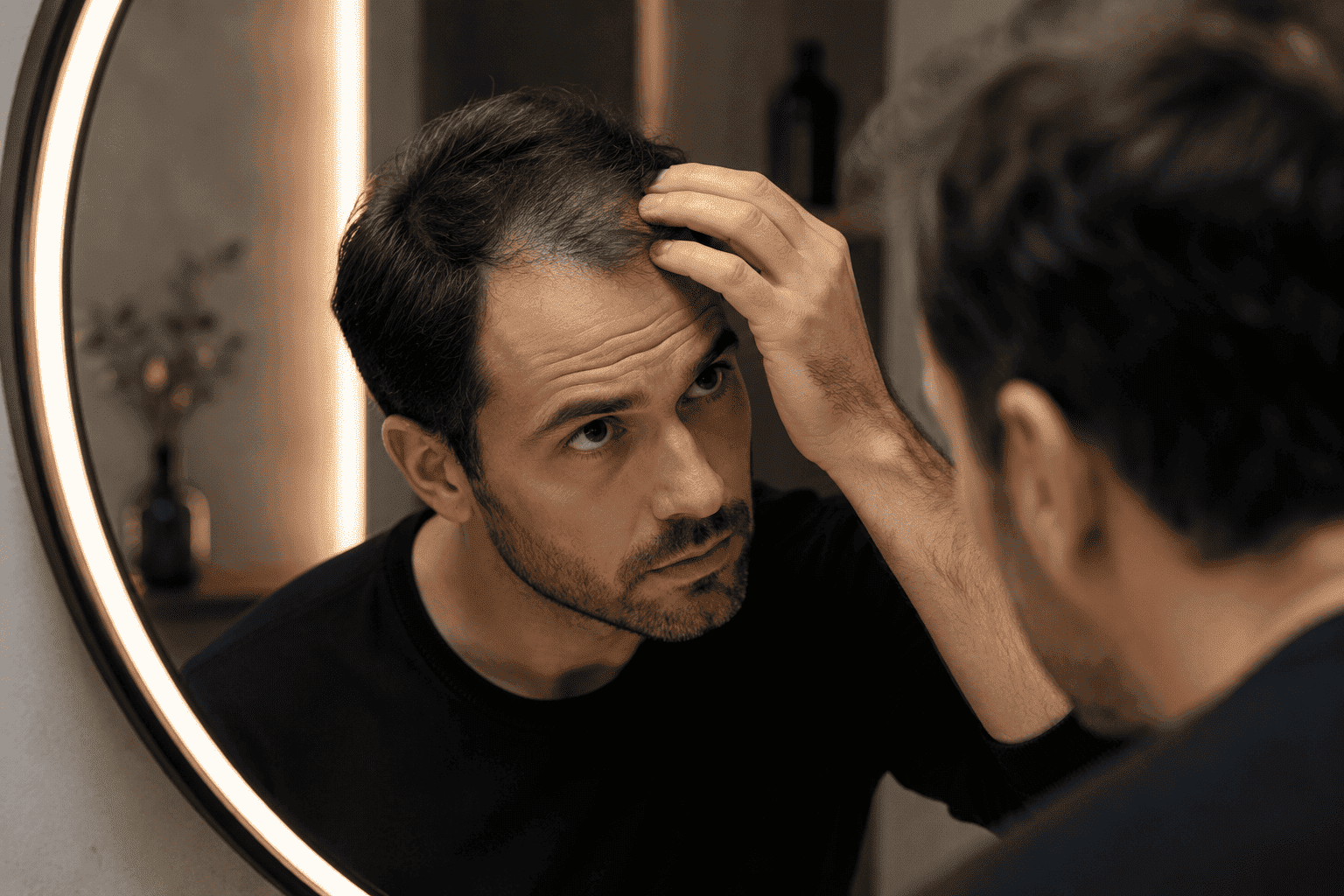
Male pattern
It usually starts at the temples and the crown, which over the years may eventually merge. It is graded using the Hamilton-Norwood scale.
See male pattern hair lossCommon baldness doesn’t appear overnight: it is a slow process in which the follicle gradually shrinks. We explain what stage you are at and how to slow it down with medical treatment.

Androgenetic alopecia is the most common cause of hair loss in both men and women. It has a genetic and a hormonal component: in people who are predisposed, the follicles in certain areas are more sensitive to androgens, especially dihydrotestosterone (DHT).
That sensitivity causes miniaturisation: with each cycle the follicle becomes smaller, the growth phase gets shorter and the hair grows back finer, shorter and with less pigment, until some follicles stop producing hair altogether. That is why, long before any bald patches appear, many people notice that their hair has lost body or that their scalp is starting to show through.
It is a chronic, progressive form of hair loss, but not every case advances at the same pace. As long as the follicle is still alive there is room to act: the aim of medical treatment is to slow miniaturisation, extend the growth phase and restore thickness to the hair you still have.
At the consultation we don’t just look at the thinnest area: we examine the whole scalp, ask how things have changed over recent years, about your medication and family history, and take standardised photographs. That way the plan is based on data rather than impressions, and we can fine-tune it at every review.
If the assessment reveals signs of another type of alopecia (scarring, alopecia areata or hair loss linked to an underlying condition), we will refer you to the appropriate specialist.
It usually starts at the temples and the crown, which over the years may eventually merge. It is graded using the Hamilton-Norwood scale.
See male pattern hair loss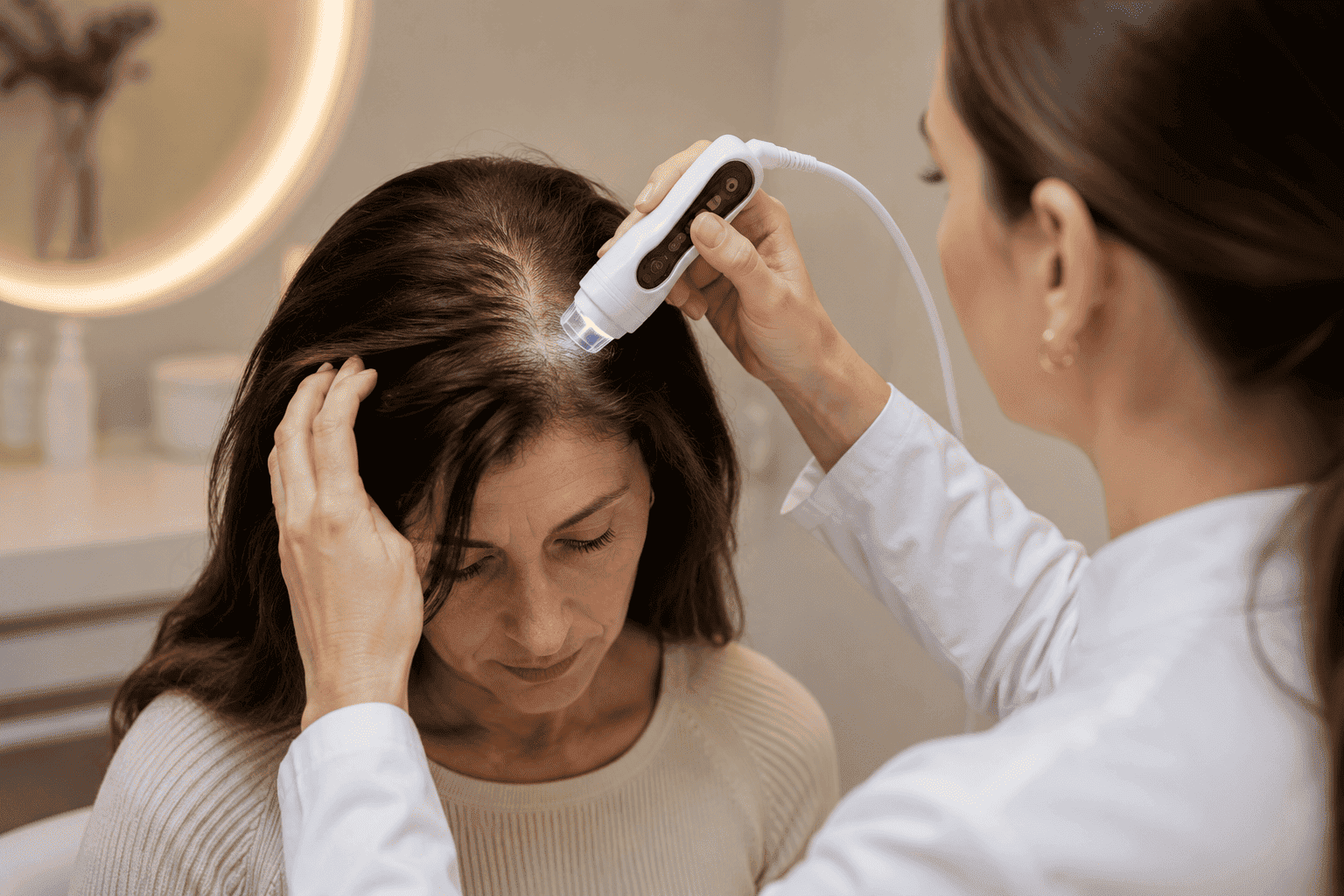
Diffuse loss of density on the top of the head, with a parting that gets wider while the front hairline is usually preserved (Ludwig scale).
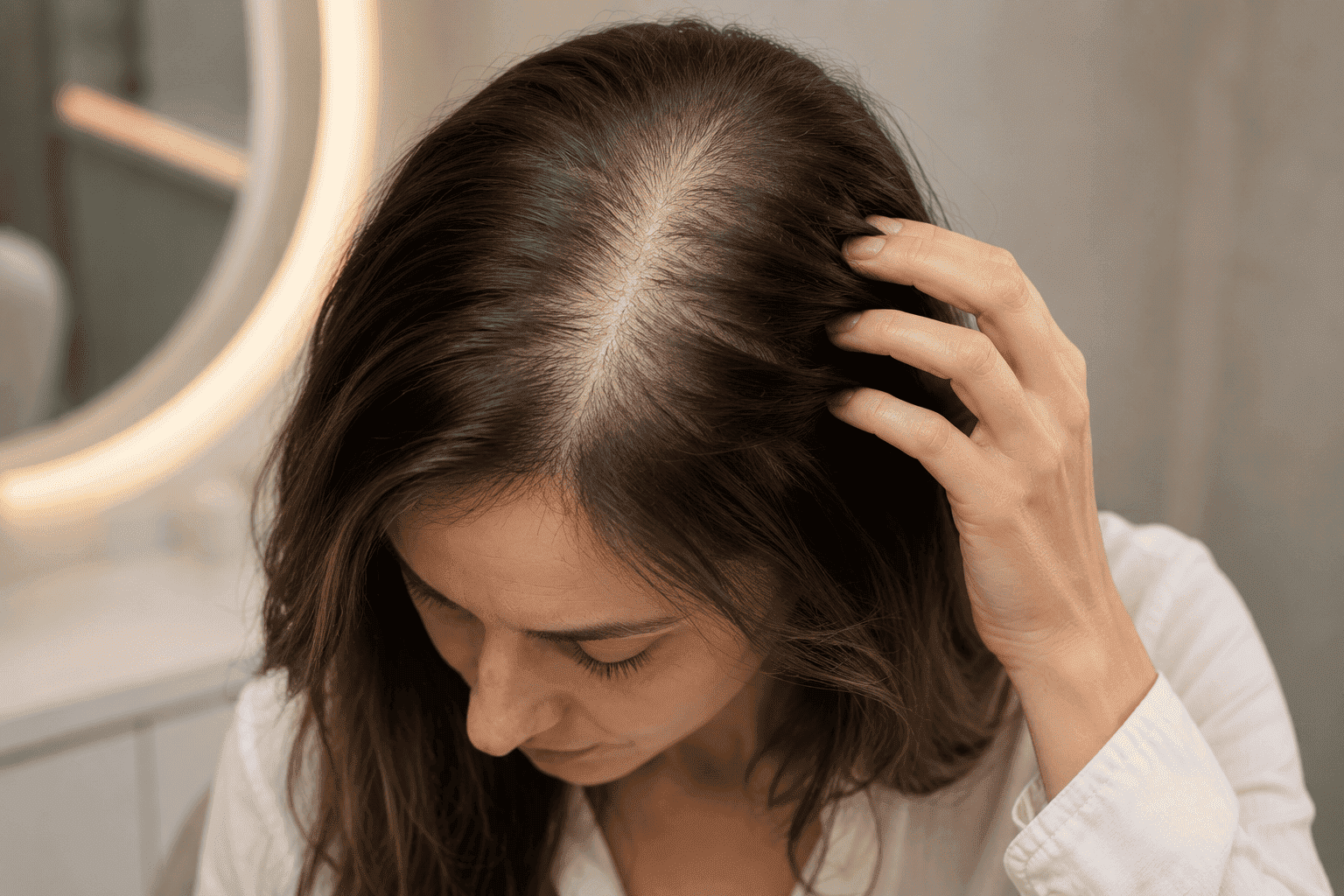
The first sign of miniaturisation: hair keeps growing, but it becomes thinner and loses volume.

Thinning at the crown is common and often goes unnoticed until someone mentions it or you see it in a photo.
We assess your case, answer your questions and explain which results are realistic for you.
We design your treatment with the most suitable techniques, an estimated number of sessions and a price, with no obligation.
We carry out the sessions at our clinic in La Carihuela and review your progress to adjust the plan.
A medical foundation treatment plus in-clinic procedures, always based on your diagnosis.
We examine the scalp under magnification to see differences in hair thickness (a sign of miniaturisation), density in each area and the condition of the skin. If needed, we request blood tests. These images serve as a baseline for measuring progress.
The doctor assesses whether topical or oral treatments that act on the hair cycle or the hormonal pathway are suitable for you, with proper monitoring and follow-up.
Platelet-rich plasma delivers growth factors to the follicle to stimulate its activity.
See hair PRPMicro-injections of active ingredients into the scalp to improve the follicle’s environment.
See hair mesotherapyTell us what you would like to improve and we will explain, with no obligation, which treatment suits you.
Calle Arenas, 12 · 29620 Torremolinos, Málaga · Get directions · Patient reviews
All treatments are subject to a prior professional assessment. Results are individual and may vary from person to person. Centro Ubud is an authorised healthcare centre in Torremolinos (Málaga). NICA 64610. Clínica UBUD S.L. · CIF B56756158.