Physiotherapy does not “erase” a bunion, but for many people with hallux valgus it can help reduce pain, improve big toe mobility and foot function, and delay or avoid the need for surgery when the deformity is not severe. The conservative approach combines exercise, manual therapy, footwear advice and, in some cases, complementary techniques. At Centro Ubud in Torremolinos (Málaga), we assess each foot individually to set realistic goals.
What is a bunion or hallux valgus?
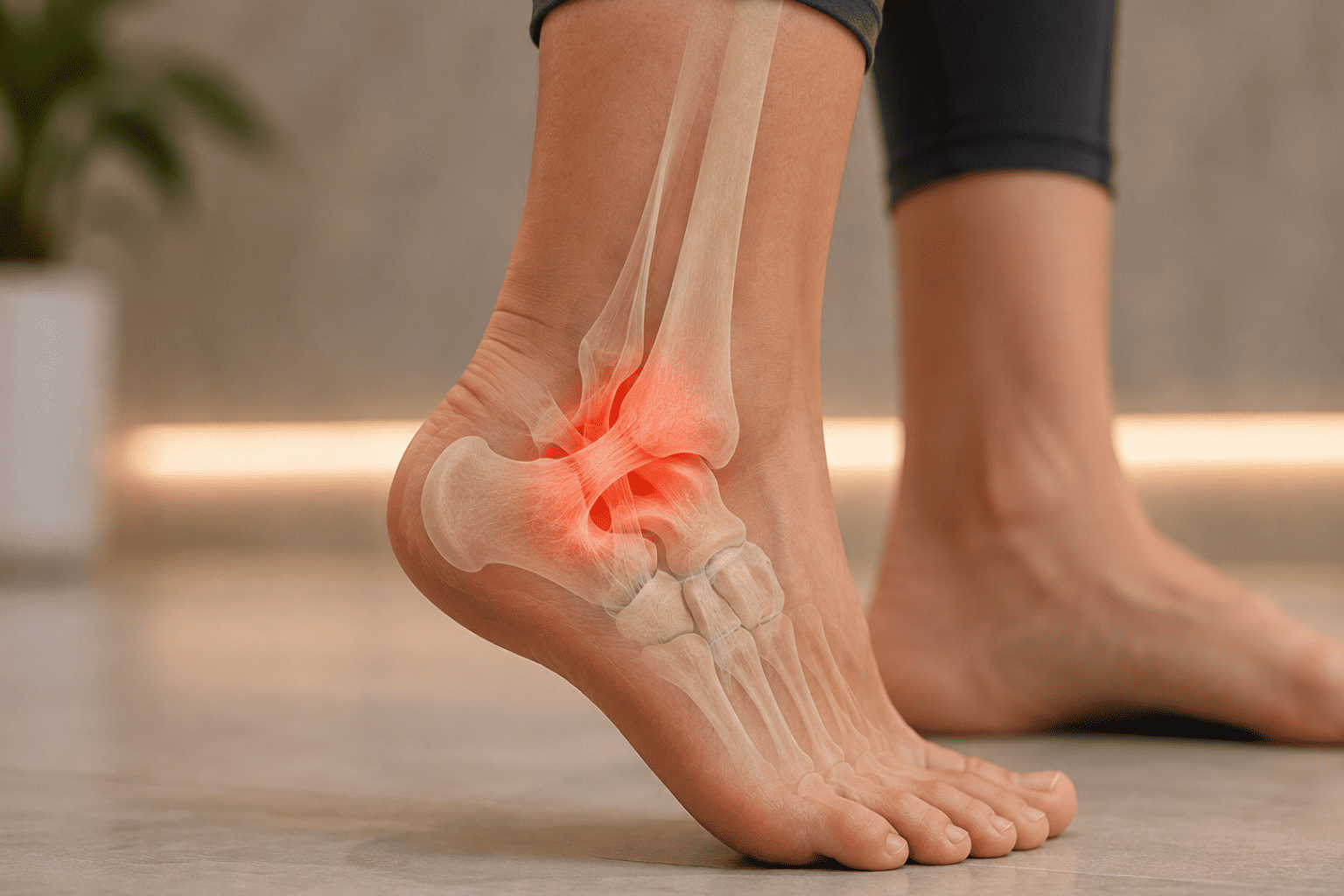
Hallux valgus is a deformity in which the big toe drifts towards the smaller toes, while the first metatarsal moves in the opposite direction. The result is a bump on the inner edge of the foot: what we call a bunion.
It is not just a “lump” of bone. It is a change in the alignment of the joint that affects how load is distributed when you walk and the muscles of the foot, and over time it can affect the neighbouring toes and the sole of the foot.
Why do bunions appear?
Hallux valgus has several contributing factors. The ones most often linked to it are:
- Family predisposition: it is common for several members of the same family to have it.
- Foot characteristics: the shape of the metatarsal head, ligament laxity or a foot that tends to flatten can make it more likely.
- Narrow-toed and heeled shoes: not considered the only cause, but they can speed up progression and increase discomfort.
- Sex: it is more common in women.
- Some rheumatic or neurological conditions, which can alter the structure of the foot.
Why does a bunion hurt?
Not all bunions are painful, and the size of the deformity does not always match how much it hurts. When there is pain, it is usually due to one or more of these causes:
- Shoes rubbing on the bump, which can irritate the bursa (a small fluid-filled sac) and the skin.
- Overload of the big toe joint, with stiffness and pain when pushing off.
- Pain in the sole of the foot, under the central metatarsals, because the big toe no longer carries its share of the weight (metatarsalgia).
- Deformities in the neighbouring toes, such as claw or hammer toes.
- Irritation of small nerves in the area, which can cause tingling or burning.
What can physiotherapy do for bunions?
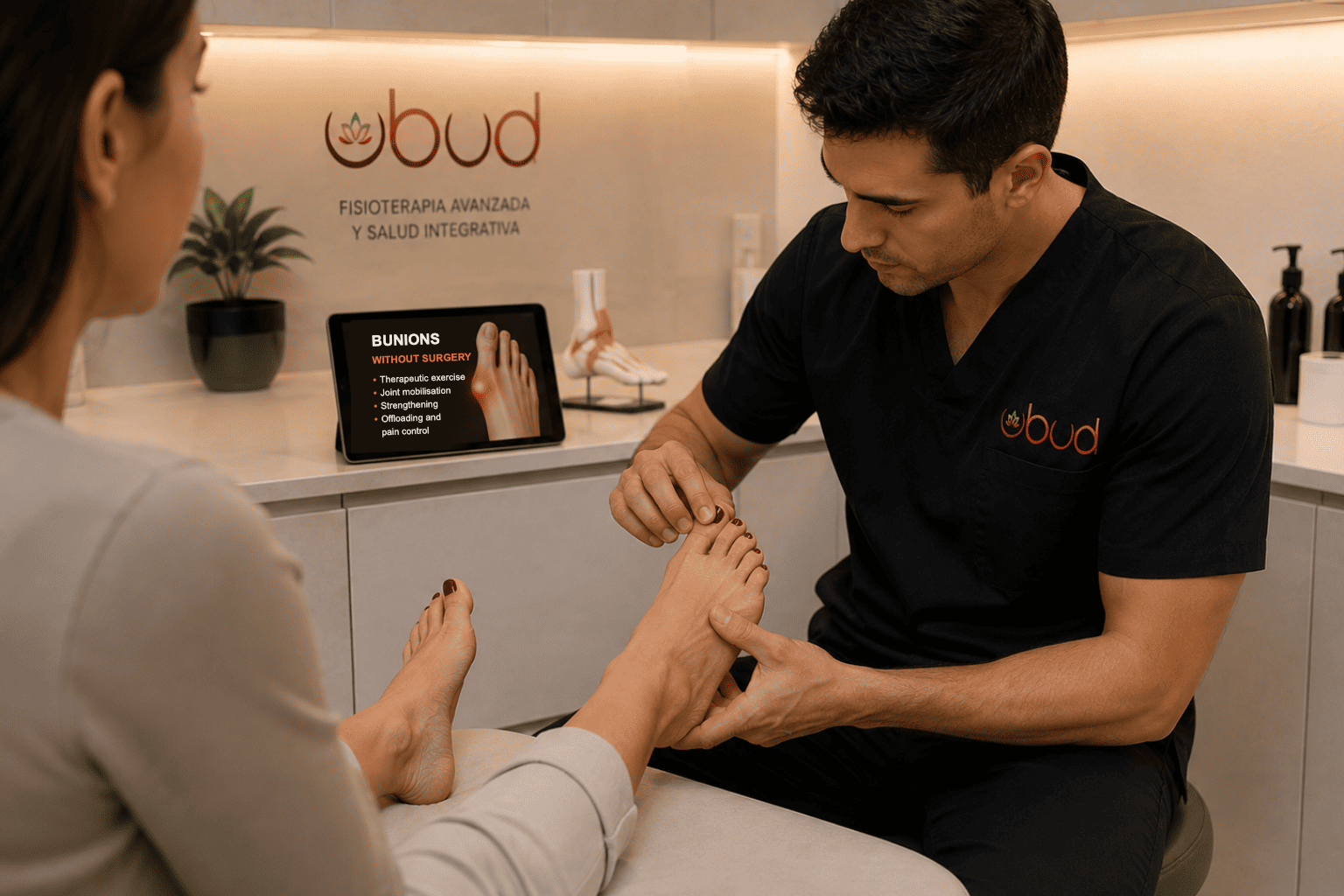
It is important to be clear: physiotherapy does not correct the bone deformity or make the bunion disappear. What it can often do is improve symptoms and function. In our physiotherapy unit we work towards these goals:
Reducing pain
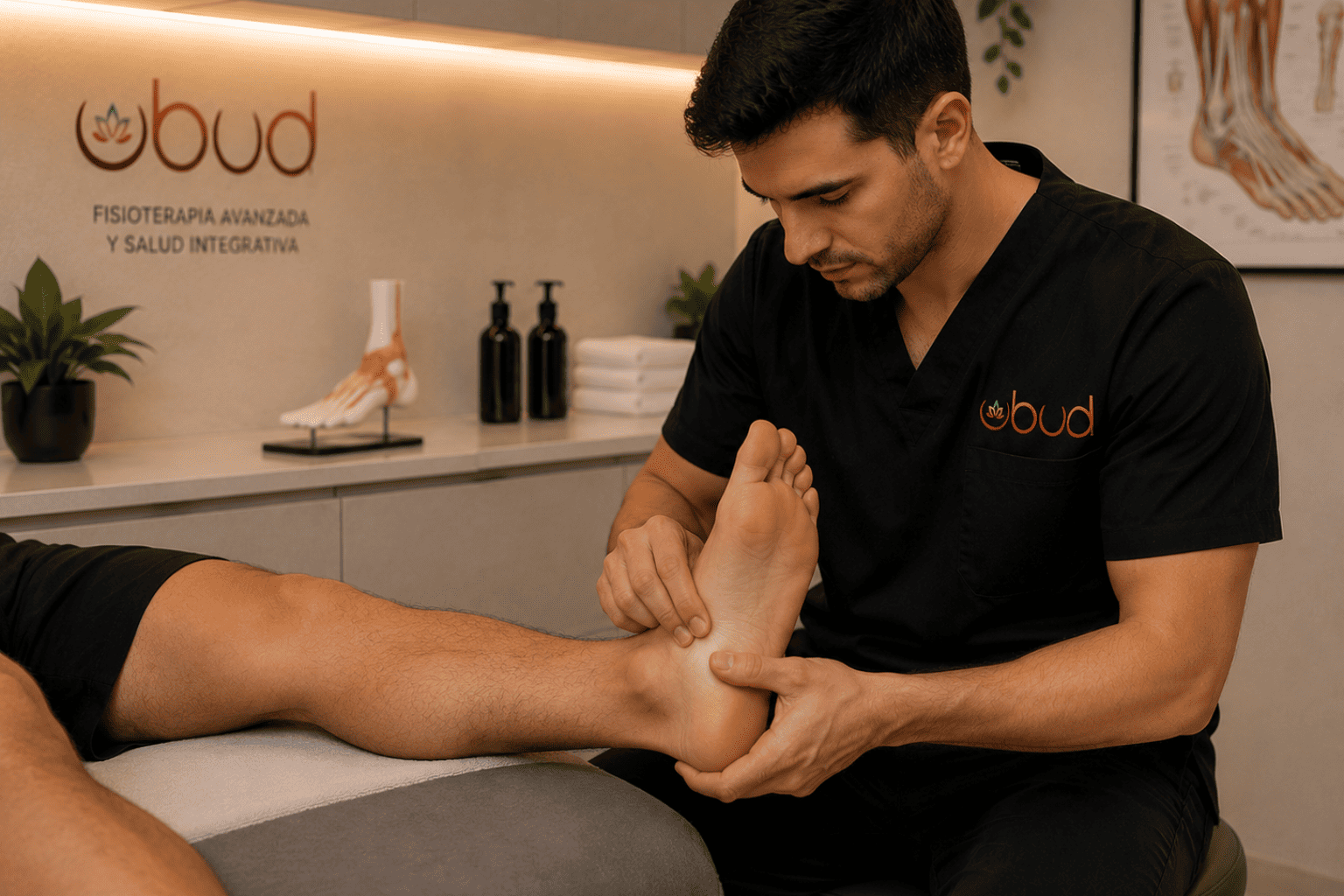
Manual therapy on the big toe joint and the tissues of the foot, together with adjusting load and footwear, can help ease everyday discomfort.
Improving big toe mobility
A stiff joint forces the foot to compensate. Mobilisation techniques and specific exercises aim to maintain or improve the mobility you need to walk more comfortably.
Strengthening the foot muscles
The intrinsic muscles of the foot, especially the abductor of the big toe, help stabilise the first toe. Progressive therapeutic exercise aims to improve control and the foot’s capacity to handle load.
Improving the way you walk
We look at how you place your foot and how the ankle, knee and hip are involved. Sometimes small corrections in walking pattern or in the strength of other areas reduce overload on the forefoot.
Complementary techniques
When there is persistent pain in tendons, bursae or tissues in the area, techniques such as shockwave therapy or ultrasound-guided invasive physiotherapy may be considered. Whether they are suitable is decided after the examination.
Free first consultation at Centro Ubud, La Carihuela (Torremolinos). Message us on WhatsApp.
Do toe separators, splints and insoles work?
These are very common questions in clinic. Generally speaking:
- Silicone separators and night splints: they can ease rubbing or discomfort for some people, but there is no evidence that they permanently correct the deformity.
- Insoles: they can help redistribute load, especially when there is pain in the sole of the foot. They should be based on an assessment of the foot and gait.
- Bunion pads: they reduce friction with shoes and can improve comfort.
These aids usually work better alongside exercise and suitable footwear than on their own.
What shoes are best if I have bunions?
Footwear is one of the simplest measures and has a big impact on comfort. Some general recommendations:
- A wide, deep toe box that does not squeeze the toes.
- Flexible materials over the bunion, with no seams that rub.
- A low or moderate heel so as not to increase load on the forefoot.
- Good hold at the heel and instep without having to squeeze the toes.
On the coast, like here on the Costa del Sol, where we spend many months in sandals or flip-flops, it is worth alternating them with shoes that give some support, especially if you walk a lot.
When is bunion surgery considered?
Surgery may be considered when pain persists and limits daily activities despite well-delivered conservative treatment, or when the deformity progresses and causes problems in other toes. The decision lies with the orthopaedic surgeon or foot surgery specialist, who will assess the options in each case.
Physiotherapy also plays an important role before and after surgery, to prepare the foot and to recover mobility and strength afterwards.
If you would like to know more about our approach, visit our page on bunion treatment without surgery in Torremolinos.
What exercises can I do at home?
Some exercises often prescribed for hallux valgus are gentle big toe mobilisation, toe-spreading work, the “short foot” exercise (activating the arch without curling the toes) or heel raises while controlling pressure through the first toe. However, the choice and progression should be tailored to each person. Doing generic exercises without an assessment may not help, and in some cases can increase discomfort.
Frequently asked questions about bunions without surgery
Can a bunion be corrected without surgery?
The bone deformity is not corrected with conservative treatment. What can often be achieved is less pain, better foot function and possibly an influence on how symptoms develop.
Do bunions get worse over time?
They can progress, but not in the same way for everyone. Footwear, daily load and the characteristics of the foot all influence how they evolve.
Is physiotherapy treatment painful?
Generally not. Some techniques can cause some discomfort, but they are always adapted to each patient’s tolerance.
At what age should a bunion be treated?
There is no specific age. If pain, stiffness or difficulty with shoes appears, it is a good time for an assessment, whether you are young or older.
Do I need imaging tests?
Not always to start conservative treatment. If surgery is being considered, the specialist usually requests weight-bearing X-rays to measure the deformity.
Free first consultation at Centro Ubud, La Carihuela (Torremolinos). Message us on WhatsApp.

Physiotherapist specialising in the foot and ankle and musculoskeletal pain, educator of physiotherapists and founder of The Fisio Program. He works with Centro Ubud’s physiotherapy unit.
This article is for information only and does not replace an individual assessment by a healthcare professional.