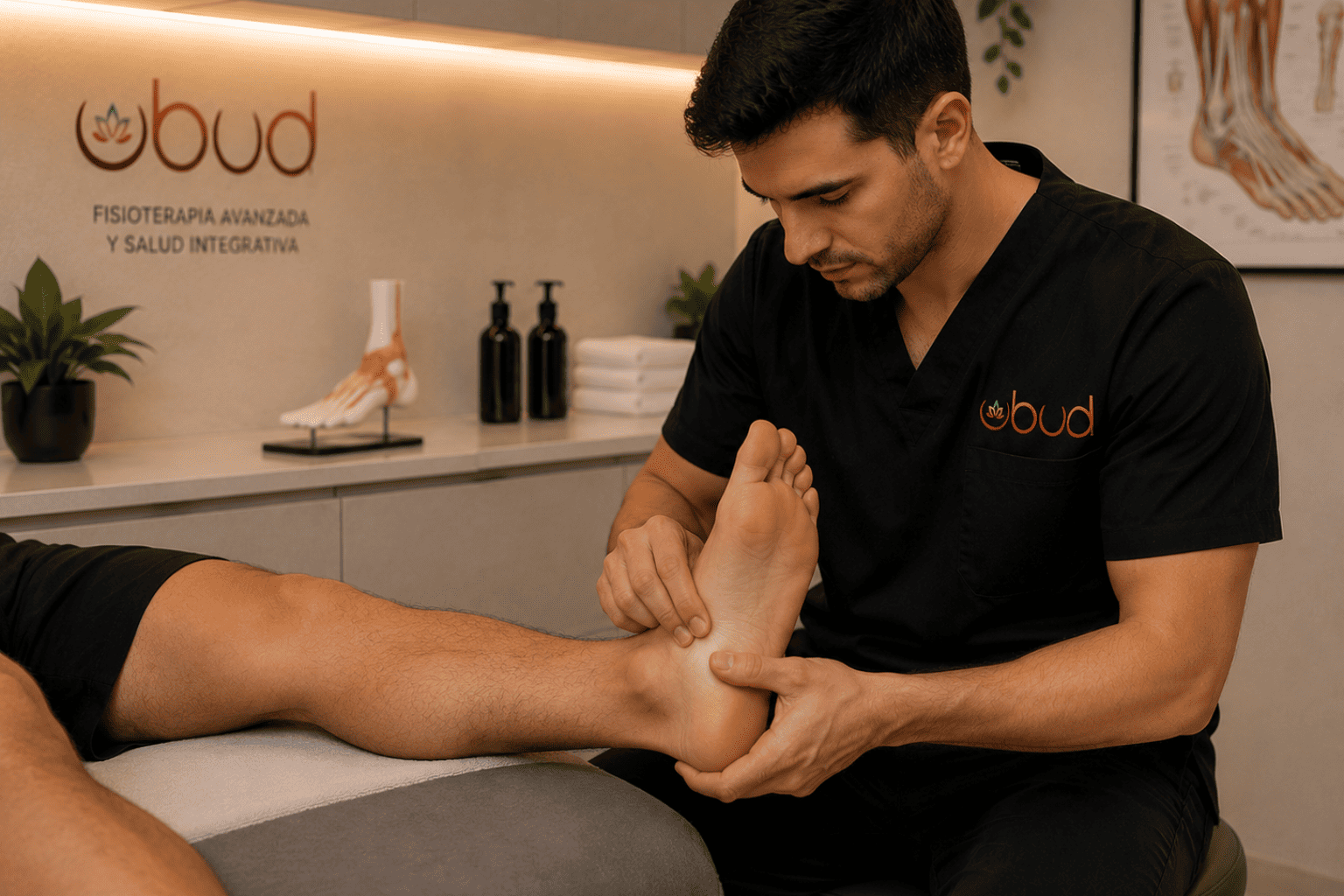
A poorly healed ankle sprain is one that, weeks or months after the injury, still causes pain, swelling, stiffness or a feeling that the ankle “gives way”. It is usually due to incomplete rehabilitation, instability that has not been worked on or associated injuries that went unnoticed. The good news is that, in many cases, a detailed assessment and a well-directed physiotherapy programme can improve ankle function. At Centro Ubud in Torremolinos, we assess each case individually to understand what is preventing recovery.
What exactly is an ankle sprain?
A sprain is an injury to the ligaments, the structures that connect bones to one another and give stability to the joint. In the ankle, the most frequent mechanism is rolling inwards (inversion), which mainly affects the lateral ligaments, especially the anterior talofibular ligament.
Depending on severity, sprains are usually classified into three grades: from a stretching of the fibres with little impact to a complete tear of the ligament. But the initial grade is not everything: even a sprain that seemed mild can leave after-effects if it is not properly rehabilitated.
Why can an ankle sprain end up poorly healed?
It is very common to think that a sprain “heals by itself” with rest and ice. In the initial phase those measures can bring relief, but the ligament needs time, progressive loading and stimulus to recover its function. These are some of the most frequent reasons why the ankle does not fully recover:
- Incomplete rehabilitation: activity is resumed when the pain goes away, but without having regained strength, mobility or balance control.
- Excessively prolonged immobilisation: in many sprains, keeping the ankle immobilised for too long can lead to stiffness and loss of strength.
- Loss of proprioception: the ligaments contain receptors that tell the nervous system the position of the ankle. After the injury, this information can be altered and the ankle reacts less well to uneven ground.
- Repeated sprains: each new twist increases the risk of the next one, creating a cycle that is hard to break without specific work.
- Undiagnosed associated injuries: sometimes the problem is not only the ligament.
What injuries can hide behind a sprain that does not improve?
When pain persists beyond what is expected, other conditions that may accompany the sprain should be ruled out. These include:
- Cartilage injuries of the talus (osteochondral lesions), which can cause deep pain and a feeling of locking.
- Involvement of the peroneal tendons, located behind the outer ankle bone, which can become irritated or injured in the same twist.
- Syndesmosis injury, the set of ligaments that joins the tibia and fibula above the ankle (the so-called “high ankle sprain”).
- Joint impingement from scar tissue trapped at the front or side of the ankle.
- Nerve irritation in the area, such as the superficial peroneal nerve, which can cause tingling or burning on the top of the foot.
- Small fractures that were not identified at the time of the injury.
That is why, if the ankle keeps hurting, the key is not to repeat the same treatment, but to find out which structure is producing the symptoms. In some cases it will be necessary to refer you to a doctor for imaging tests.
What symptoms suggest the sprain has not recovered well?
These are the most common signs of a poorly healed ankle sprain:
- Persistent pain on the outer or front part of the ankle, especially when walking on uneven ground, running or jumping.
- Swelling that appears at the end of the day or after activity.
- A feeling of instability or of the ankle “giving way”, with repeated twists.
- Stiffness, especially when bending the ankle upwards (for example, when going downstairs or squatting).
- Difficulty keeping your balance on one leg.
- Clicking, locking or a feeling that something “catches” inside the joint.
When the feeling of giving way and repeated twists continue over time, this is called chronic ankle instability, a common condition that is best addressed as soon as possible.
Free first consultation at Centro Ubud, La Carihuela (Torremolinos). Message us on WhatsApp.
How is an ankle that keeps hurting assessed?
Assessment is the starting point. In the consultation we review the history of the injury (how it happened, how many times it has recurred, what treatments have been tried) and carry out an examination of the foot and ankle that includes:
- Palpation of ligaments, tendons and other structures to locate the source of the pain.
- Ligament stability tests.
- Assessment of joint mobility, especially dorsiflexion.
- Balance, strength and control tests in single-leg stance.
- Analysis of gait and of the movements that provoke symptoms, such as running or jumping.
Musculoskeletal ultrasound can be a useful tool to assess ligaments and tendons in real time. If an injury is suspected that requires other tests or a specialist medical assessment, the appropriate referral is recommended.
How is a poorly healed ankle sprain treated with physiotherapy?
Treatment is adapted to what is found during the assessment. In our physiotherapy unit in Torremolinos we combine different strategies:
Regaining mobility
Many ankles that have suffered sprains are left stiff. Manual therapy techniques and mobility exercises help to recover joint range, especially dorsiflexion, which is essential for walking, running and going downstairs normally.
Progressive strengthening
Strength work for the ankle muscles, the peroneals, the calf and also the hip improves the ankle’s ability to bear loads. It is prescribed progressively and adapted to each person’s tolerance.
Proprioceptive and balance training
This is one of the pillars with the best scientific support for reducing the risk of new sprains. It starts with simple balance exercises and progresses to unstable surfaces, changes of direction and jumping, according to each patient’s goals.
Complementary techniques
In some cases, when there is persistent pain in tendons or scar tissue, techniques such as ultrasound-guided invasive physiotherapy or shockwave therapy may be considered. They are always indicated after the examination and as part of a broader plan, never in isolation.
Gradual return to activity
The ultimate goal is to walk, work or play sport with confidence again. For this, a gradual return is planned, with functional criteria that show when the ankle is ready for each level of demand.
How long does it take to recover the ankle?
There is no single timeframe. It depends on how long the problem has been present, the number of previous sprains, any associated injuries and how consistently you do the exercise. Some people notice improvement within a few weeks, while others need a longer process. The important thing is to follow a plan with measurable goals and review it regularly.
When might surgery be necessary?
Most cases of chronic instability are initially managed conservatively. When instability or symptoms persist after a well-conducted rehabilitation programme, or when there are injuries that require it, an assessment by orthopaedics and trauma may be considered. That decision always belongs to the specialist doctor.
If, in addition to the ankle, you have discomfort in other areas of the foot, you can see our page on foot and ankle pain in Torremolinos.
Frequently asked questions about a poorly healed ankle sprain
Is it normal for a sprain to keep hurting after several months?
It is not what would be expected. If pain, swelling or instability persist after two or three months, an assessment is advisable to identify the cause and adjust the treatment.
Is physiotherapy worthwhile if the sprain was years ago?
Yes, in many cases. Even if the injury is old, the strength, mobility and control of the ankle can be trained. The response varies from person to person, which is why a prior assessment is important.
Should I wear an ankle support permanently?
It is not usually necessary. An ankle support or strapping can be useful at specific times, such as when returning to sport, but they do not replace strength and balance work.
Can I run if my ankle is unstable?
It depends on the degree of instability and on the symptoms. Often some adapted activity can be maintained while recovery is being worked on. Your physiotherapist will advise what is reasonable at each stage.
Do I need an MRI scan?
Not always. Clinical examination and, where appropriate, ultrasound provide a great deal of information. If an injury to the cartilage, bone or another structure is suspected and requires it, the appropriate medical assessment will be recommended.
Free first consultation at Centro Ubud, La Carihuela (Torremolinos). Message us on WhatsApp.

Physiotherapist specialising in the foot and ankle and musculoskeletal pain, educator of physiotherapists and founder of The Fisio Program. He works with Centro Ubud’s physiotherapy unit.
This article is for information only and does not replace an individual assessment by a healthcare professional.