Patellar tendinopathy, or “jumper’s knee”, is an overload injury of the tendon that connects the kneecap to the shin bone: it hurts just below the kneecap when you jump, run, climb stairs or squat, and in most cases it improves with a well-dosed progressive loading programme, not with rest alone. At Centro Ubud, in La Carihuela (Torremolinos), we approach it with a thorough assessment, ultrasound when you need it and a therapeutic exercise plan tailored to your sport and your daily life.
What is patellar tendinopathy and why does it appear?
The patellar tendon transmits the force of the quadriceps to straighten the knee. When it receives more load than it can tolerate and does not have enough time to adapt, its structure changes and pain appears. We now know that this is not so much “inflammation” as a problem of tendon capacity: that is why the correct term is tendinopathy rather than tendinitis, although the two are often used interchangeably. If you want to learn more about the difference, there is more information on our page about tendinitis in Torremolinos.
It is very common in sports involving jumps and changes of pace: volleyball, basketball, padel, football, athletics, CrossFit or beach volleyball, which is very popular on the beaches of Torremolinos, Benalmádena and the rest of the Costa del Sol. It also appears in runners who suddenly increase their mileage or hill work.
Factors that increase the risk
- Sudden increases in training volume or intensity.
- Intense pre-seasons or returning to sport after a break.
- Hard surfaces or changes of footwear and surface (for example, moving from court to sand).
- Insufficient strength in the quadriceps, glutes or calves.
- Ankle or hip stiffness that forces the knee to work harder.
- Insufficient rest and sleep during periods of heavy load.
What are the symptoms of jumper’s knee?
The main symptom is very localised pain at the bottom of the kneecap, which you can usually point to with one finger. Other common signs are:
- Pain when you start training that eases as you warm up and returns afterwards, especially the next day.
- Discomfort when jumping, landing, braking or doing deep squats.
- Pain when going down stairs or standing up after sitting for a long time.
- A feeling of stiffness in the front of the knee in the morning.
- Loss of performance: you jump less or avoid certain movements.
Not all pain at the front of the knee is patellar tendinopathy. Patellofemoral pain, irritation of Hoffa’s fat pad, Osgood-Schlatter disease in teenagers or meniscus problems can feel similar. That is why a good assessment is key; you can read about other causes on our page about knee pain in Torremolinos.
How is patellar tendinopathy diagnosed in Torremolinos?
The diagnosis is essentially clinical. Your physiotherapist will take a detailed history (when it started, which sport you play, how your load has changed) and carry out an examination: palpation of the tendon, loading tests such as the decline squat or single-leg hop, and assessment of strength and mobility of the hip, knee and ankle.
What is ultrasound used for?
Ultrasound allows us to see the tendon in real time: its thickness, any areas of altered structure, increased blood flow or signs of other nearby injuries. We use it when it provides useful information for clinical reasoning, to rule out other causes or to guide techniques such as invasive physiotherapy. It is worth knowing that the image does not always match the pain: some tendons show changes on ultrasound but do not hurt, and vice versa, so the image is always interpreted together with the examination.
Free first consultation at Centro Ubud, La Carihuela (Torremolinos). Message us on WhatsApp.
Why is rest alone not enough?
This is the question we are asked most often in clinic. Complete rest may calm the pain for a few days, but the tendon loses load capacity. When you go back to training, it is just as weak as before, or weaker, and the pain comes back. It is the typical cycle of “stop, improve, return, relapse”.
Tendons adapt to load: they need well-dosed mechanical stimulus to remodel and become more resilient. What is usually helpful is modifying the load: temporarily reducing jumps or the movements that irritate the tendon most, without stopping moving, while building strength progressively. Anti-inflammatories or ice may provide short-term relief, but they do not solve the underlying problem.
What does physiotherapy treatment for patellar tendinopathy involve?
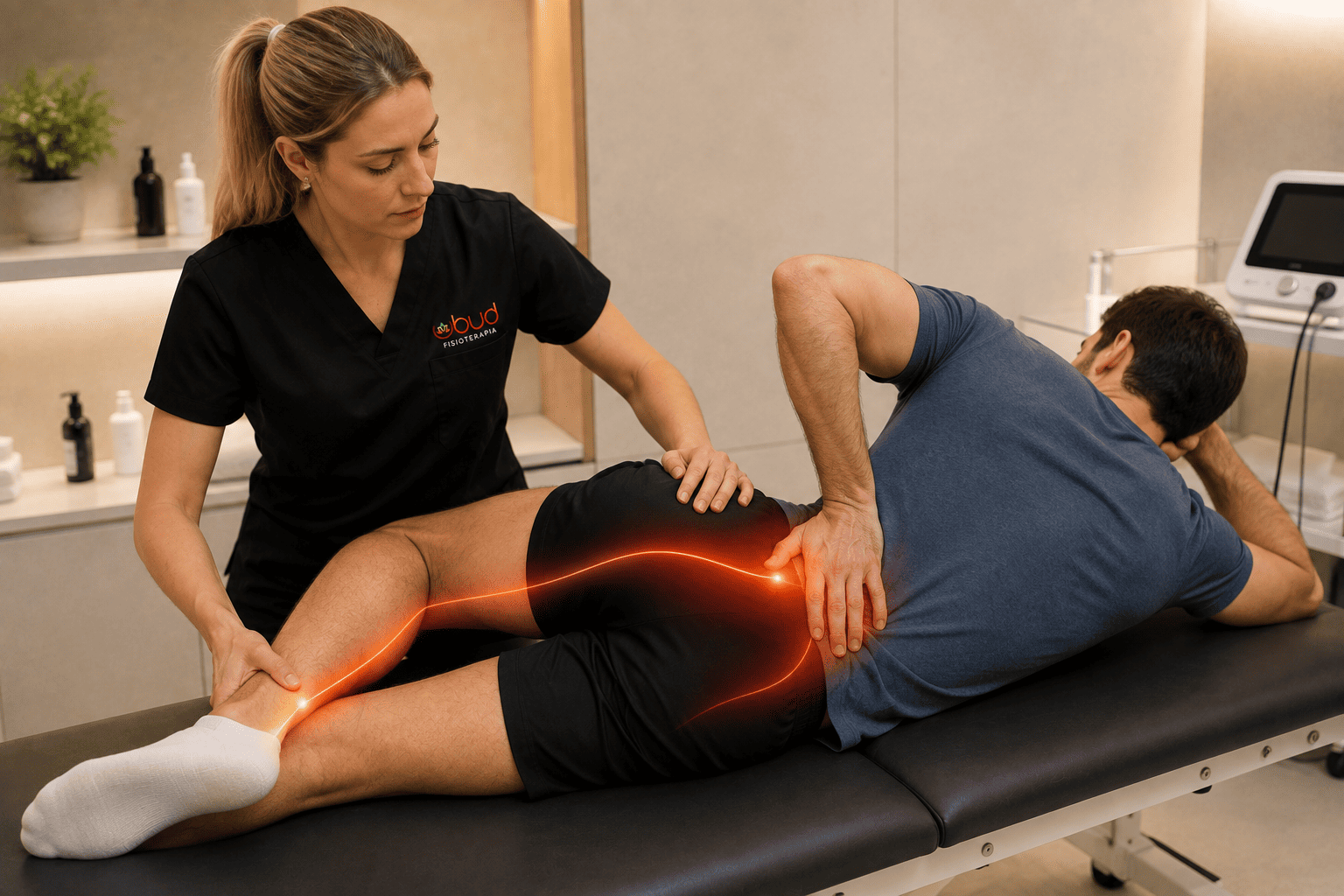
Our physiotherapists work globally: good diagnosis and clinical reasoning, manual therapy when needed, ultrasound when you need it, invasive physiotherapy if indicated and, always, therapeutic exercise as the core of treatment.
Progressive loading programme: the core of treatment
Current evidence places progressive exercise as the best-supported treatment for patellar tendinopathy. It is usually organised in phases, adapted to your pain and to how you respond over the following 24 hours:
- Pain control: isometric exercises (for example, holding a partial squat or a knee extension on a machine), which often reduce pain and allow you to stay active.
- Strength: slow, heavy quadriceps exercises such as leg press, squats or extensions, together with work for the glutes and calves.
- Energy storage: gradual introduction of jumps, landings and fast movements.
- Sport-specific: changes of direction, repeated jumps and movements specific to your discipline until you tolerate the real load of training and competition.
A certain level of discomfort during exercise can be acceptable if it stays low and does not get worse the next day. Your physiotherapist will teach you how to use this as a guide to adjust the load. You can find out how we approach this work on our page about therapeutic exercise in Torremolinos.
Manual therapy when needed
Manual therapy can help relieve pain, improve ankle or hip mobility and make it easier for you to tolerate exercise. It does not replace the loading programme, but it can be a good complement at specific moments.
Shockwave therapy and invasive physiotherapy, if indicated
In persistent tendinopathies that do not progress well with exercise alone, shockwave therapy or ultrasound-guided invasive physiotherapy techniques, such as percutaneous electrolysis, may be considered. They are always used to support exercise, never as a stand-alone treatment, and only after an assessment confirms they are suitable for you.
How long does it take to heal and when can I return to sport?
Patellar tendinopathy requires patience: tendons adapt slowly. Many people notice improvement within a few weeks, but completing the process and returning to jumping normally usually takes several months. Timescales vary greatly and depend on how long you have had the problem, your sporting level, your consistency with the programme and the initial assessment.
Rather than a date, we use criteria to decide on the return to sport:
- Low, stable pain during and after loading exercises.
- Similar quadriceps strength in both legs.
- Tolerance of jumps, landings and changes of direction without worsening the next day.
- A gradual return to training before competing.
If you play sport in Torremolinos, Benalmádena or Málaga and want a tailored plan, our sports injuries unit in Torremolinos will support you throughout the process. To book an appointment, message us on WhatsApp.
When should you see a doctor?
See a doctor if you notice significant swelling, warmth or redness in the knee, fever, a snap followed by an inability to straighten the leg (this may indicate a rupture), locking, intense night pain or if the pain started after a hard blow. In teenagers with pain below the kneecap, it is also advisable to rule out other growth-related causes.
Frequently asked questions
Can I keep playing sport with patellar tendinopathy?
In many cases yes, by modifying the load. The movements that irritate the tendon most are temporarily reduced and the activity you tolerate well is maintained while you progress through the strength programme.
Is patellar tendinitis the same as patellar tendinopathy?
They are used as synonyms, but the correct term is tendinopathy, because the main problem is not inflammation but a change in the tendon’s capacity to tolerate load.
Does a knee brace or patellar strap help?
Some people find it relieves pain during activity, but it is only a temporary aid. It does not replace therapeutic exercise or correct the cause of the problem.
Do I need an MRI for the diagnosis?
Usually not. The diagnosis is clinical and ultrasound provides additional information when needed. MRI is reserved for unclear cases or those that do not progress, at the doctor’s discretion.
Which exercises can I do at home?
Isometrics and quadriceps strength exercises can usually be done at home, but the dose and progression should be adjusted to your case after an assessment to avoid relapses.
Can it be prevented from coming back?
Keeping up regular strength work, increasing training load gradually and respecting rest reduces the risk of relapse, although it does not eliminate it completely.
Free first consultation at Centro Ubud, La Carihuela (Torremolinos). Message us on WhatsApp.

Physiotherapist specialising in the foot and ankle and musculoskeletal pain, educator of physiotherapists and founder of The Fisio Program. He works with Centro Ubud’s physiotherapy unit.
This article is for information only and does not replace an individual assessment by a healthcare professional.