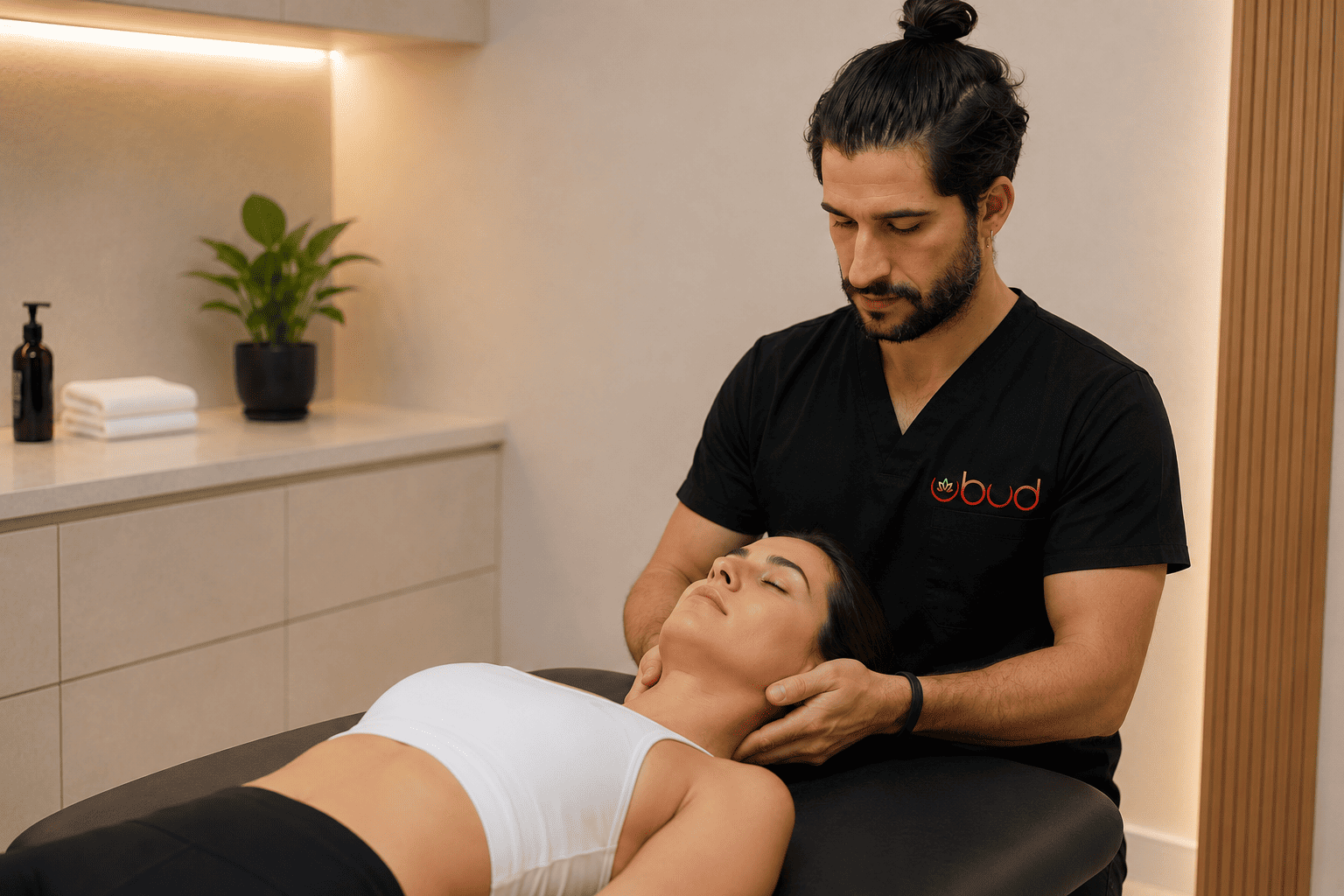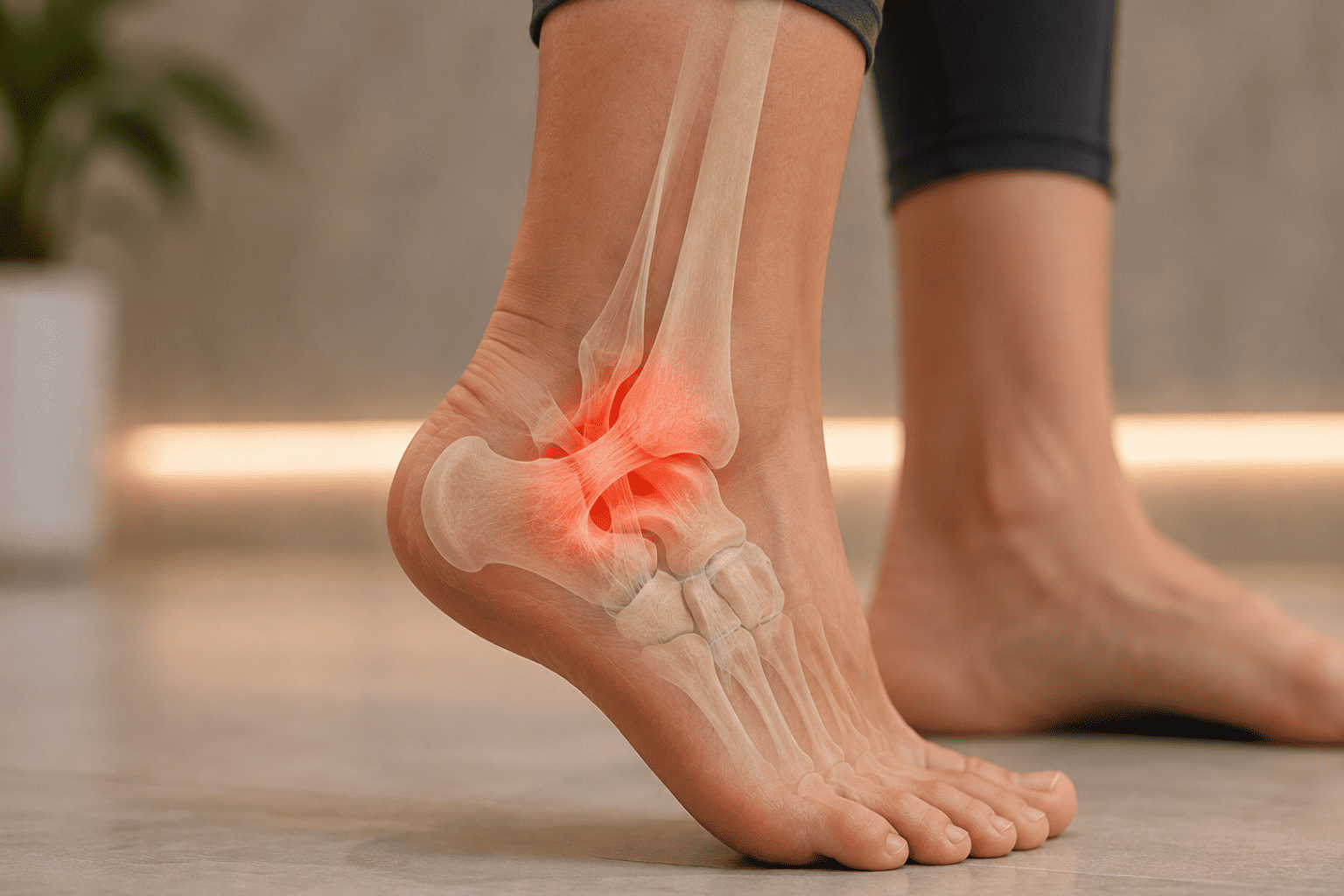
A gait analysis is an assessment of how you place your foot and how your whole body moves when you walk and run; it helps to understand the origin of certain complaints and to decide on treatment, which does not always involve insoles. At Centro Ubud, in La Carihuela (Torremolinos), we approach it from a physiotherapy perspective: first we understand what is happening and why, and then we choose what you really need.
What exactly is a gait analysis?
When people hear “gait analysis”, many imagine a platform that draws the footprint and, from there, a pair of insoles. In reality, a good analysis is much broader. It means observing how load is distributed across the foot, how the ankle, knee and hip behave while walking and running, and how your strength, mobility, footwear and daily activity play a part.
The foot is the base, but it does not work alone. A knee that drifts inwards, a hip with poor control or a stiff ankle can completely change the way you land. That is why looking only at the footprint falls short: what matters is interpreting what we see within your clinical history and your symptoms.
What is assessed in a gait analysis in Torremolinos?
In our gait analysis service in Torremolinos we follow a logical order:
- Clinical interview: where it hurts, since when, what makes it worse, what sport you do, what footwear you use and whether you have had previous injuries.
- Examination on the couch: mobility of the ankle, big toe and hip, strength of the foot and leg muscles, and specific tests depending on the area.
- Weight-bearing assessment: how you stand, balance on one leg, squat or step up.
- Walking and running analysis: observation and video recording to review each phase of the stance calmly.
- Footwear check: the wear on your trainers provides a great deal of information.
When a tissue injury is suspected (tendon, fascia or ligament), the physiotherapist can use the ultrasound scanner to refine the diagnosis in the same session, if you need it.
Who is a gait analysis useful for?
Not everyone needs one. It is especially useful if:
- You run or walk a lot and have complaints that keep coming back.
- You have pain in the sole of the foot, the heel, the Achilles tendon or the front of the foot.
- You notice knee, shin or hip pain related to activity.
- You are about to start running or significantly increase your training volume and want to do it sensibly.
- You have bunions, claw toes or a very flat or very high-arched foot that causes problems.
- You already use insoles and notice no improvement, or you wonder whether you still need them.
In children, a flexible, pain-free flat foot is usually part of normal development. It is only worth assessing if there is pain, frequent tiredness, falls or noticeable asymmetries.
Which injuries are related to the way you walk?
The way you land can influence the load certain tissues receive, although it is almost never the only cause. Among the problems we see most often in patients from Torremolinos, Benalmádena and the rest of the Costa del Sol are:
- Plantar fasciitis or fasciopathy: heel pain, especially with the first steps in the morning.
- Achilles tendinopathy: pain and stiffness at the back of the ankle.
- Medial tibial stress syndrome (shin splints): pain along the inner shin, very typical in runners.
- Patellofemoral pain: discomfort around the kneecap when running, going downstairs or sitting for long periods. If this sounds familiar, you may be interested in our page on knee pain in Torremolinos.
- Iliotibial band syndrome: pain on the outer side of the knee.
- Metatarsalgia and Morton’s neuroma: pain or tingling in the front of the foot.
- Recurrent ankle sprains and instability.
In all these cases, training load, rest, strength and footwear matter as much as, or more than, the shape of the foot.
Free first consultation at Centro Ubud, La Carihuela (Torremolinos). Message us on WhatsApp.
When are insoles needed and when are they not?
This is one of the most important ideas: insoles are not always necessary. Current evidence indicates that they can help reduce pain in the short term in some conditions, but they do not “correct” your gait for good, nor do they replace active work.
When might insoles make sense?
- As temporary support to offload an irritated tissue while you work on strength.
- In marked structural deformities or stiff feet that cause pain.
- In some people with diabetes, rheumatic diseases or neurological conditions, always in coordination with their doctor or podiatrist.
- When, after trying other measures, you notice a clear improvement with them.
When do you probably not need them?
- If you have a flat or high-arched foot but no pain or limitations.
- If your problem is better explained by a sudden increase in load or a lack of strength.
- If they are recommended only on the basis of a footprint drawing, without a full assessment.
When we think insoles could help you, we explain why and point you in the right direction; and when they are not needed, we tell you that clearly too.
Why are exercise and foot strength so important?
The foot has its own muscles, known as the intrinsic muscles, which help support the arch and absorb impact. When they are trained, stability and load tolerance improve. Add to that the strength of the calf and soleus, the quadriceps and the glutes, which are the main shock absorbers when walking and running.
That is why, in most cases, the core of treatment is a programme of therapeutic exercise tailored to you. Some common examples:
- “Short foot” exercises to activate the arch without curling the toes.
- Progressive heel raises, first on both legs and then on one leg and with added load.
- Balance work on one leg and on unstable surfaces.
- Knee and hip control exercises, such as single-leg squats or step-ups.
- A structured progression of running load: volume, pace and terrain.
Results vary from person to person and depend on the assessment, consistency and the type of injury, but exercise is the tool with the strongest scientific support for most of these problems.
How does the physiotherapist work at Centro Ubud?
Our physiotherapists work with a global approach. We start from a good diagnosis and sound clinical reasoning and, from there, combine what each case needs: manual therapy when it adds value, ultrasound when we need to see the tissue, invasive physiotherapy if indicated and, almost always, therapeutic exercise as the foundation. You can find out more about our physiotherapist in Torremolinos.
If you live in Torremolinos, Benalmádena, Málaga or anywhere on the Costa del Sol and would like us to assess your gait, message us on WhatsApp and we will tell you what the first session involves.
When should you see a doctor?
A gait analysis does not replace a medical assessment. See your doctor if you have:
- Severe pain after a knock or a fall, or you are unable to put weight on the foot.
- Significant swelling, warmth and redness, especially with a fever.
- Tingling, loss of sensation or progressive weakness.
- Wounds on the foot that do not heal, especially if you have diabetes.
- Night pain that does not ease with rest.
Frequently asked questions
How long does a gait analysis take?
It depends on the case, but it usually takes a full session including interview, examination and video analysis. If needed, it is complemented with ultrasound during the same visit.
Do I need to bring anything to the appointment?
Bring comfortable clothes, shorts if possible, the trainers you train or walk in every day and, if you use them, your current insoles. Previous reports or imaging tests also help.
Does a gait analysis always end with insoles?
No. In many cases treatment is based on exercise, load adjustments and, if needed, manual therapy or other physiotherapy techniques. Insoles are one more tool, not the default answer.
Is it useful if I do not play sport?
Yes. It is useful for anyone with foot, ankle or knee pain when walking, working on their feet or climbing stairs, whether they play sport or not.
How often should I repeat it?
There is no fixed frequency. It makes sense to repeat it if your symptoms or activity level change, or when you finish a treatment programme to check your progress.
Is it the same as seeing an osteopath?
No. Centro Ubud does not offer osteopathy as such. A physiotherapist is a regulated healthcare professional trained in functional diagnosis, therapeutic exercise, manual therapy and techniques such as ultrasound or invasive physiotherapy, which allows for a more complete approach.
Free first consultation at Centro Ubud, La Carihuela (Torremolinos). Message us on WhatsApp.

Physiotherapist specialising in the foot and ankle and musculoskeletal pain, educator of physiotherapists and founder of The Fisio Program. He works with Centro Ubud’s physiotherapy unit.
This article is for information only and does not replace an individual assessment by a healthcare professional.