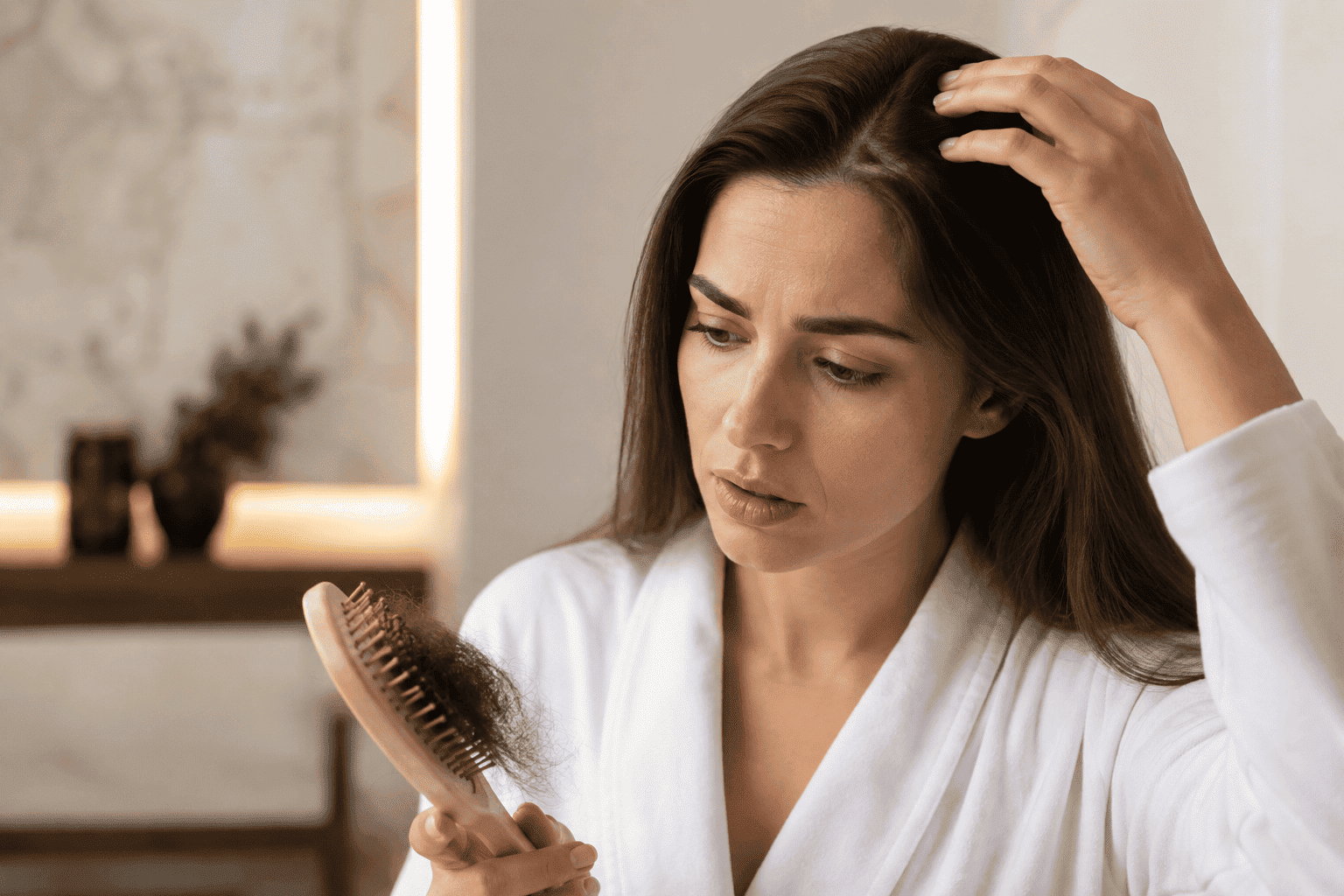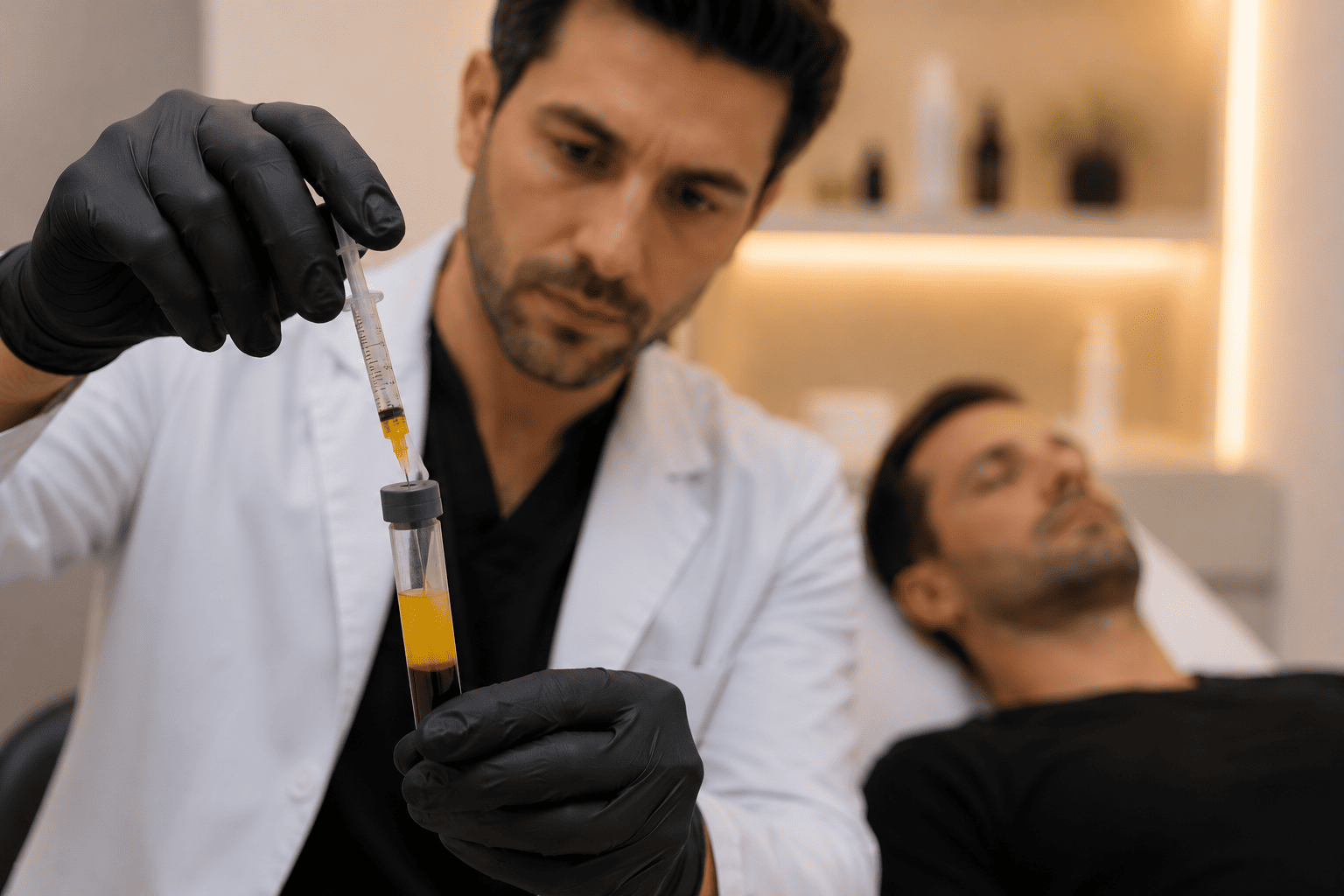
Hair PRP uses growth factors obtained from your own blood to stimulate the follicle, whereas hair mesotherapy applies micro-injections of a cocktail of vitamins, amino acids and other active ingredients that nourish the scalp; neither is better in the abstract: the choice depends on the type of alopecia, its stage and your goals, and in many cases the two are combined. At Centro Ubud, in La Carihuela (Torremolinos), we always decide after a free medical assessment in which a doctor examines your scalp before suggesting anything.
What is hair PRP?
PRP (platelet-rich plasma) is an autologous treatment: a small sample of your blood is taken, centrifuged to separate the plasma fraction with the highest concentration of platelets, and injected into the scalp through superficial micro-injections. Platelets release growth factors involved in tissue repair and in the cellular signalling of the hair follicle.
Because it comes from your own body, the risk of allergic reactions is very low. The usual discomfort is mild: stinging or tenderness for a few hours and, occasionally, a small bruise where the blood was drawn.
What is hair mesotherapy?
Hair mesotherapy involves applying, also through superficial micro-injections, a blend of substances selected by the doctor: B-group vitamins, biotin, amino acids, minerals, antioxidants or ingredients that act on microcirculation, among others. The formula is tailored to each case and to the goal.
Its aim is to improve the environment in which hair grows: delivering nutrients right where they are needed, supporting blood flow to the scalp and backing up the hair growth cycle.
How do PRP and hair mesotherapy differ?
Although the application technique is similar, the logic behind each treatment is different:
- Origin of the product: PRP is autologous (it comes from your blood); mesotherapy uses a prepared blend of external ingredients.
- Main mechanism: PRP acts mainly as a biological signal that stimulates the follicle; mesotherapy acts more as nutritional support for the scalp.
- Procedure: PRP requires a blood draw and processing on the same day; mesotherapy needs no blood draw.
- Scientific evidence: PRP has more studies in androgenetic alopecia, with promising though variable results; the evidence for mesotherapy is more mixed, partly because every formula is different.
- Typical use: PRP is usually considered when there is miniaturisation and loss of density; mesotherapy when diffuse shedding, weak hair or a scalp in need of support predominates.
Which one suits me best for my type of alopecia?
This is the key question, and the honest answer is that it depends on the diagnosis. Androgenetic alopecia is not the same as telogen effluvium or alopecia areata, and treatment must be adjusted accordingly. As a general guide:
Androgenetic alopecia in men and women
This is the most common cause of progressive loss of density. Here PRP is often one of the most interesting options as a complement to the underlying medical treatment, because it aims to stimulate follicles that are miniaturising. If this is your case, you can read more about male pattern hair loss in Torremolinos.
Diffuse shedding or telogen effluvium
When hair falls out all over after a period of stress, childbirth, a restrictive diet or an illness, the first step is to identify and correct the cause. Mesotherapy can help support the scalp while the hair cycle returns to normal.
Fine, weak or dull hair
If there is no established alopecia but you notice your hair is more fragile, mesotherapy is often a good first option thanks to its nourishing approach.
Other types of alopecia
Scarring alopecias, alopecia areata or those linked to autoimmune or thyroid conditions require specific investigation and often dermatological follow-up. In these cases it is not advisable to start any aesthetic treatment without a clear diagnosis.
Free first consultation at Centro Ubud, La Carihuela (Torremolinos). Message us on WhatsApp.
Can PRP and hair mesotherapy be combined?
Yes, and it often makes sense. Because they work through different pathways, they can complement each other: PRP provides the biological stimulus and mesotherapy the nutritional support. Some protocols alternate sessions of each; others start with one and add the second depending on the response. Both can also be accompanied by whatever medical treatment the doctor considers appropriate, a blood test to rule out deficiencies and habits that look after your hair.
Combining them is neither compulsory nor the best option for everyone: it is decided at the assessment, based on your diagnosis and on how your hair responds.
How many sessions are needed?
The exact number is personalised, but in general terms both treatments are planned in two phases:
- Initial phase: several sessions at short intervals (usually every two to four weeks for mesotherapy and somewhat further apart for PRP) during the first few months.
- Maintenance phase: more widely spaced sessions, every few months, to maintain what has been achieved, especially in androgenetic alopecia, which is a chronic process.
Each session is short, is done in the consulting room and lets you return to your routine the same day. It is best to avoid washing your hair, intense exercise and swimming pools for the following hours, as the doctor advises.
What results can I realistically expect?
Hair has a slow cycle, so patience is part of the treatment. Typically you first notice less shedding and, later on, improvements in thickness and density, which are usually assessed from three to six months onwards. Results vary from person to person and depend on the type of alopecia, how long it has been developing and whether active follicles remain.
Neither treatment restores areas where the follicle has already disappeared; in that case other alternatives would need to be considered. That is why the sooner you act, the more room there is. To understand the problem as a whole, we recommend our guide on hair loss and alopecia in Torremolinos.
Why is diagnosis so important before choosing?
Choosing PRP or mesotherapy “just to try” is the quickest way to waste time. At the assessment, the doctor reviews your medical history, the shedding pattern, family history and the condition of your scalp, and may use trichoscopy and a blood test (iron, thyroid, vitamins) to rule out treatable causes. With that information the most suitable plan is proposed, which sometimes includes referral to a dermatologist.
At Centro Ubud, an authorised medical clinic in La Carihuela, hair PRP and hair mesotherapy are always performed by a doctor, aiming for natural results. We see patients from Torremolinos, Málaga, Benalmádena and the whole Costa del Sol; if you would like your free assessment, message us on WhatsApp.
When are they not indicated and when should you check first?
There are situations in which these treatments are not recommended or must be assessed with caution:
- Pregnancy and breastfeeding.
- Active infection or lesions on the scalp.
- Clotting disorders, low platelets or anticoagulant treatment (especially for PRP).
- Active cancer or uncontrolled autoimmune diseases.
- Known allergy to any component of the blend (in mesotherapy).
Also see your doctor if the hair loss is very sudden, appears in patches or comes with itching, pain, heavy flaking or general symptoms such as tiredness or changes in weight.
Frequently asked questions
Does PRP or hair mesotherapy hurt?
You feel a slight prick and some stinging. Most patients tolerate it well and the discomfort disappears within a few hours.
Which is more effective, PRP or mesotherapy?
It depends on the case. In androgenetic alopecia PRP has more scientific backing; for diffuse shedding or weakened hair mesotherapy may be enough. The medical assessment makes the difference.
Can I have these treatments if I am a woman?
Yes. Both are useful in female hair loss, although in women it is especially important to rule out hormonal causes, iron deficiency or thyroid disorders.
Does more hair fall out after the first sessions?
Some people may notice temporary shedding at first, because the hair cycle is reactivated. It is usually short-lived, but always mention it at your check-up.
Do the results last if I stop treatment?
In chronic processes such as androgenetic alopecia, the underlying trend continues, so maintenance sessions and medical follow-up are usually recommended.
Free first consultation at Centro Ubud, La Carihuela (Torremolinos). Message us on WhatsApp.

Written and reviewed by the medical team at Centro Ubud, an aesthetic medicine, advanced aesthetics and physiotherapy clinic in La Carihuela, Torremolinos.
This article is for information only and does not replace an individual assessment by a healthcare professional.