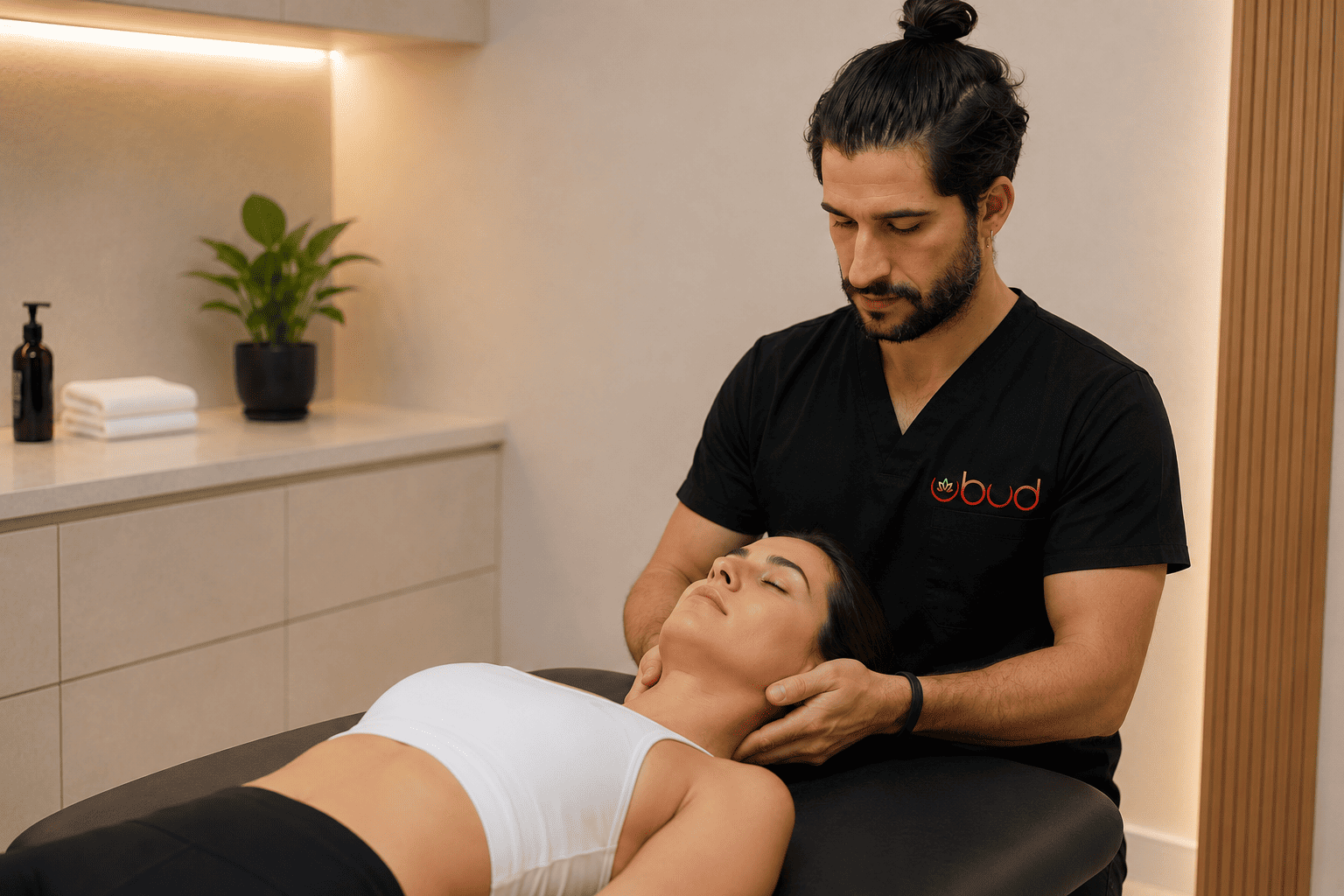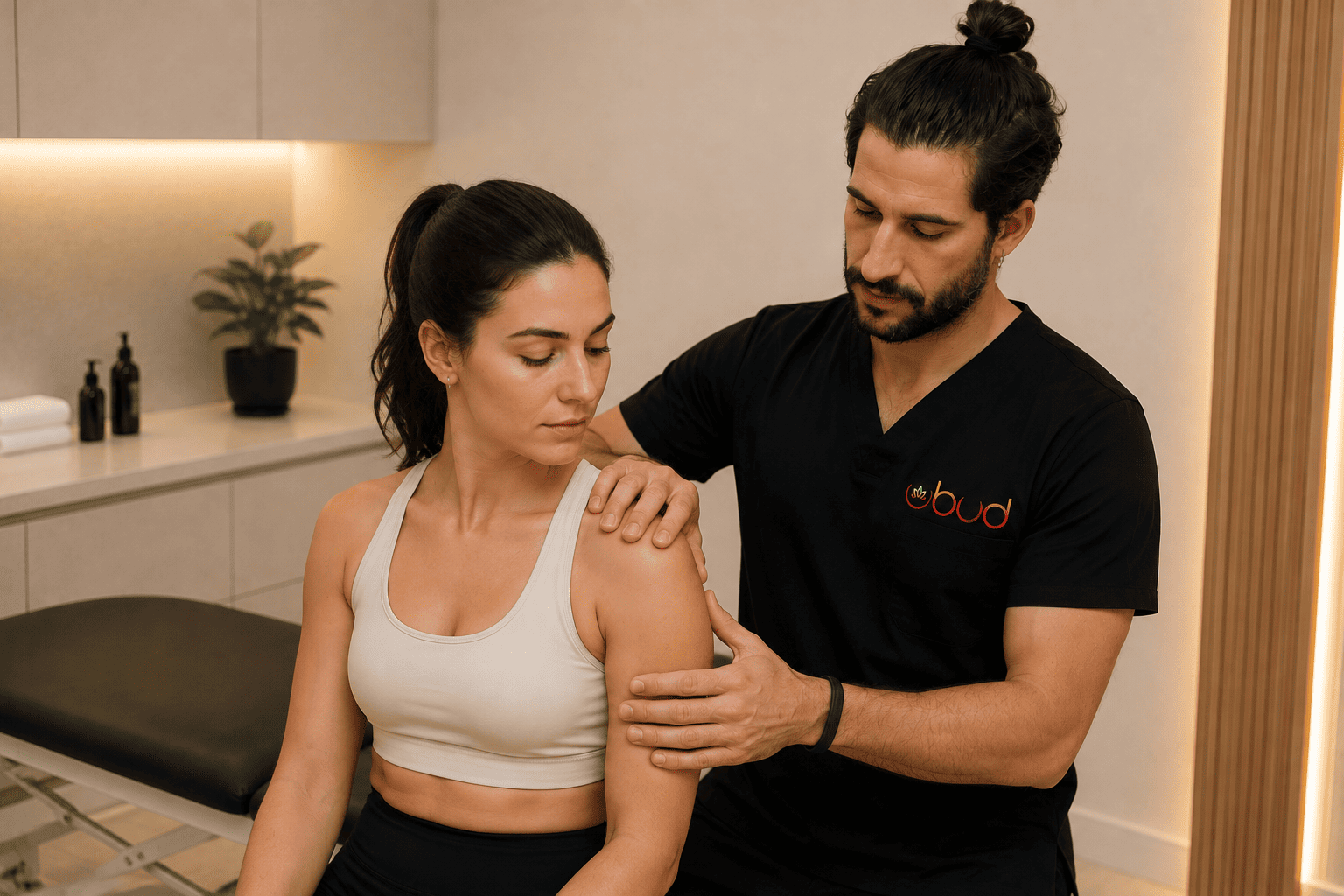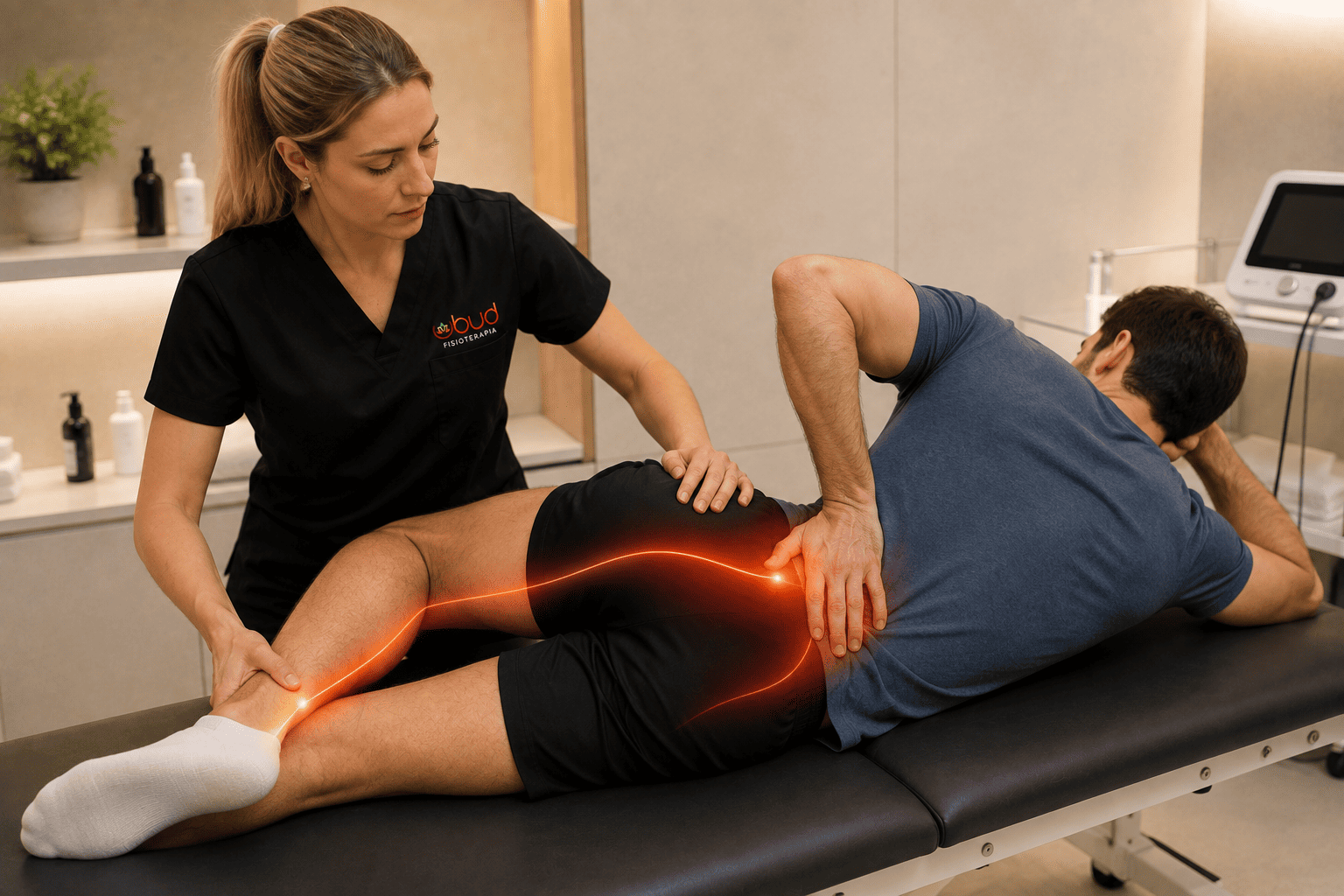
Sciatica in Torremolinos is best treated when a physiotherapist first confirms whether the pain really comes from a nerve root or whether it is referred pain from the spine, the hip or the pelvic muscles; from there, education, manual therapy when needed, therapeutic exercise and, only if indicated, ultrasound-guided invasive techniques are combined. At Centro Ubud, in La Carihuela (Torremolinos), we approach sciatica globally: we assess calmly, reason out the origin of the pain and design a plan tailored to you and your daily life.
What exactly is sciatica?
In everyday language we call “sciatica” any pain that travels from the lower back or buttock down the leg. Clinically, true sciatica (lumbosacral radiculopathy) occurs when a nerve root that forms the sciatic nerve becomes irritated or compressed, often due to a herniated or bulging disc, spinal stenosis or degenerative changes. The pain usually runs along the back or side of the leg, often below the knee, and may come with tingling, numbness or loss of strength.
The good news is that most episodes of sciatica improve over time with well-directed conservative management. Scientific evidence supports staying active, understanding what is happening and doing progressive exercise, rather than the complete bed rest that used to be recommended.
Is it true sciatica or referred pain? This is how we tell them apart
Many people who come to our clinic in Torremolinos convinced they have sciatica actually have referred pain: pain felt in the leg but originating in another structure, such as the facet joints, the sacroiliac joint, the hip or muscles like gluteus medius or piriformis. Telling them apart is key, because the treatment changes completely.
Which clues point to true sciatica?
- Leg pain is worse than back pain and usually travels below the knee.
- It follows a specific path (dermatome) and is described as burning, electric or stabbing.
- There is tingling, numbness or a feeling that the leg has “gone to sleep”.
- Changes in strength, reflexes or sensation appear on examination.
- Neurodynamic tests, such as the straight leg raise, reproduce your symptoms.
And when is it usually referred pain?
Referred pain tends to be more diffuse, deep and poorly localised, often stays above the knee and is not accompanied by neurological changes. It usually varies with certain postures or movements of the hip or pelvis, and the neurological examination is normal.
Free first consultation at Centro Ubud, La Carihuela (Torremolinos). Message us on WhatsApp.
How does a physiotherapist treat sciatica in Torremolinos?
There is no magic technique for sciatica. What makes the difference is a good diagnosis and clinical reasoning that guides every decision. At Centro Ubud our physiotherapists work globally and choose their tools according to what they find in your assessment.
1. Assessment and clinical reasoning
We start with a detailed interview: how the pain began, what makes it worse and better, how you sleep, your work, your physical activity and your goals. Then we carry out a full physical and neurological examination, plus neurodynamic and mobility tests. If you already have an MRI, we review it, but we always interpret it in the context of your symptoms: many herniations that show up on imaging do not cause pain.
2. Education and load management
Understanding what is going on reduces fear and improves recovery. We explain which movements you can keep doing, how to temporarily adapt your activity without stopping moving, and which positions may ease the pain during the most irritable phases.
3. Manual therapy when needed
Manual therapy (mobilisations, neurodynamic techniques, soft tissue work) can help reduce pain and make movement easier in the early stages. We use it when it adds value, not as a stand-alone treatment, and always as a bridge towards exercise.
4. Ultrasound when you need it
Musculoskeletal ultrasound allows us to assess structures in real time, such as the sciatic nerve as it passes through the buttock, the deep muscles or the hip. It is especially useful for ruling out other causes of pain and for guiding invasive techniques precisely.
5. Percutaneous neuromodulation and invasive physiotherapy, if indicated
In some cases of persistent neuropathic pain we consider percutaneous neuromodulation in Torremolinos: we apply a low-intensity electrical current through a fine needle placed near the nerve under ultrasound guidance. Its aim is to modulate pain and support functional recovery. It is not suitable for everyone and the response varies from person to person, so it is always decided after the assessment.
6. Therapeutic exercise
Therapeutic exercise is the cornerstone of treatment in the medium and long term. We design a progressive programme that includes mobility, motor control, strengthening of the trunk, glutes and legs, and nerve gliding exercises. Progression is adjusted to your response: the goal is for you to regain confidence and capacity to do what you enjoy, whether that is walking along the Carihuela seafront, working or getting back to sport.
How long does sciatica take to improve?
It depends on the cause, the intensity, how long you have had it and the individual. Many patients notice improvement in the first few weeks with well-targeted treatment, while others need more time. Results vary and always depend on the initial assessment. If your sciatica is related to a disc herniation, you can find more information on our page about herniated discs in Torremolinos.
When should you see a doctor about sciatica? Red flags
Physiotherapy is an effective option for most cases of sciatica, but some situations require urgent medical assessment. Go to A&E or see your doctor if you have:
- Loss of bladder or bowel control, or difficulty passing urine.
- Numbness in the genital or perineal area or the inner thighs (“saddle” anaesthesia).
- Progressive or significant loss of strength in one or both legs, such as being unable to stand on your toes or heels.
- Symptoms in both legs at the same time.
- Fever, unexplained weight loss, a history of cancer or severe night pain that does not change with position.
- Pain after significant trauma, such as a fall or an accident.
If you have none of these signs, physiotherapy can be a good starting point, and if we detect anything during treatment that needs further investigation, we will refer you to a doctor. To book your assessment, message us on WhatsApp.
Frequently asked questions
Is rest good for sciatica?
Complete rest is not recommended. The most helpful approach is to stay active within what you can tolerate, temporarily adapting your activity and avoiding only what clearly increases your symptoms.
Do I need an MRI before seeing a physiotherapist?
In most cases, no. An MRI is reserved for when there are red flags, significant neurological deficit or the pain does not improve after several weeks of treatment. A thorough clinical examination usually guides the diagnosis.
What is the difference between sciatica and low back pain?
In low back pain the back is the main issue; in sciatica, leg pain with nerve-related features dominates. Both can occur together. If your pain is centred on your back, see our page on low back pain in Torremolinos.
Does percutaneous neuromodulation hurt?
A very fine needle is used and the current is low-intensity. You may feel a tingling sensation or a small muscle twitch, which is generally well tolerated. We always explain the procedure beforehand and it is only applied if indicated.
Do you see patients from Benalmádena and Málaga?
Yes. We are on Calle Arenas, in La Carihuela (Torremolinos), and we see patients from Benalmádena, Málaga city and other parts of the Costa del Sol.
Can I keep playing sport with sciatica?
Often yes, by adapting the intensity and type of activity. Your physiotherapist will tell you what you can keep doing and how to progress safely back to your usual level.
Free first consultation at Centro Ubud, La Carihuela (Torremolinos). Message us on WhatsApp.

Physiotherapist specialising in the foot and ankle and musculoskeletal pain, educator of physiotherapists and founder of The Fisio Program. He works with Centro Ubud’s physiotherapy unit.
This article is for information only and does not replace an individual assessment by a healthcare professional.